Finding a mesh WiFi system capable of covering a large house can be challenging, especially with the need for consistent speeds and reliable connections across multiple floors. The best overall pick, TP-Link Deco X68, balances strong coverage with easy setup. For those prioritizing ultra-fast connectivity, the NETGEAR Orbi 770 Series offers impressive speed and wide coverage. Meanwhile, the Amazon eero 6+ provides a budget-friendly option suitable for simpler large homes. Each choice involves tradeoffs, like cost versus performance or ease of use versus advanced features. Keep reading for a detailed breakdown to help you find the perfect system for your large house.

Get the little things that make your day delivered free with Prime
- Fast, free delivery on millions of items
- Prime Video, Amazon Music and more included
- Member-only deals all year
Key Takeaways
- Tri-band systems generally outperform dual-band options in large homes by reducing congestion and boosting speeds.
- WiFi 6 and WiFi 7 systems provide future-proof performance, but WiFi 6 often offers better value for most large house needs.
- Coverage claims are often ideal conditions; real-world performance depends heavily on home layout and construction materials.
- Ease of setup and management is a key differentiator—higher-end models tend to be more user-friendly.
- Higher price points usually correlate with better coverage, faster speeds, and more advanced features, but not always necessary for all users.
| TP-Link Deco Tri Band Mesh WiFi 6 System (Deco X68 2-Pack) |  | Best Value Tri-Band | WiFi Standard: WiFi 6 AX3600 | Bands: Tri-band | Coverage: 5,500 sq. ft. | VIEW ON AMAZON | See Our Full Breakdown |
| Amazon eero 7 Dual-Band Mesh Wi-Fi 7 Router (3-Pack, Newest Model) |  | Best for Future-Proof Speeds on a Budget | Wi-Fi Standard: Wi-Fi 7 (dual-band) | Max Internet Plan: Up to 2.5 Gbps | Wireless Speed: Up to 1.8 Gbps | VIEW ON AMAZON | See Our Full Breakdown |
| TP-Link Deco XE75 Pro AXE5400 Tri-Band WiFi 6E Mesh System (3-Pack) | 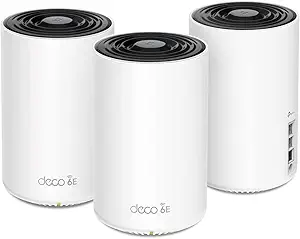 | Best Overall for Large Homes | WiFi Standard: WiFi 6E (AXE5400) | Bands: Tri-band (6 GHz, 5 GHz, 2.4 GHz) | Coverage: Up to 7,200 sq. ft. | VIEW ON AMAZON | See Our Full Breakdown |
| eero Pro 7 Tri-Band Mesh Wi-Fi 7 Router (3-Pack) |  | Best Premium Pick | Wi-Fi Standard: Wi-Fi 7 | Bands: Tri-band | Coverage: 6,000 sq. ft. | VIEW ON AMAZON | See Our Full Breakdown |
| Amazon eero 6+ Mesh WiFi System (3-pack) |  | Best Budget Pick for Smart Homes | WiFi Standard: Wi-Fi 6 (160 MHz channel support) | Coverage: Up to 4,500 sq. ft. | Max Internet Speed: Up to a gigabit | VIEW ON AMAZON | See Our Full Breakdown |
| TP-Link Deco X20 Dual-Band WiFi 6 Mesh System (3-Pack) |  | Best Budget Wi-Fi 6 Coverage | Wi-Fi Standard: Wi-Fi 6 AX1800 | Coverage: Up to 5,800 sq. ft. (3-pack) | Max Connected Devices: 150 | VIEW ON AMAZON | See Our Full Breakdown |
| NETGEAR Orbi 370 Series WiFi 7 Mesh System (3-Pack), Up to 6,000 sq ft Coverage |  | Best Premium Future-Proofing | Wi-Fi Standard: WiFi 7 | Coverage: Up to 6,000 sq. ft. | Max Speed: Up to 5 Gbps | VIEW ON AMAZON | See Our Full Breakdown |
| eero Pro 6E Mesh Wi-Fi System (3-Pack) |  | Best for Busy, Device-Heavy Households | Wi-Fi Technology: Wi-Fi 6E | Coverage: 6,000 sq. ft. | Connected Devices: 100+ | VIEW ON AMAZON | See Our Full Breakdown |
| TP-Link Deco X55 AX3000 WiFi 6 Mesh System (3-Pack) |  | Best Blend of Price and Performance | Wi-Fi Standard: Wi-Fi 6 (AX3000) | Coverage: 6,500 sq. ft. | Devices Supported: 150 | VIEW ON AMAZON | See Our Full Breakdown |
| TP-Link Deco S4 Whole Home Mesh WiFi System (2-Pack) |  | Best Starter Mesh for Mid-Size Homes | Wi-Fi Standard: Wi-Fi 5 AC1900 (3×3, 6-stream) | Coverage: Up to 3,800 sq. ft. (2-pack) | Device Capacity: Up to 75 devices | VIEW ON AMAZON | See Our Full Breakdown |
| TP-Link Deco X55 Pro AX3000 Whole Home Wi-Fi 6 Mesh System (3-Pack) |  | Best Overall for Large House Coverage and High-Speed Wired Backhaul | Wi-Fi Standard: Wi-Fi 6 (AX3000) | Coverage: Up to 6,500 sq. ft. | Speed: Up to 2,402 Mbps (5 GHz), 574 Mbps (2.4 GHz) | VIEW ON AMAZON | See Our Full Breakdown |
| NETGEAR Orbi 770 Series WiFi 7 Mesh System (3-Pack), Up to 8,000 sq ft Coverage |  | Best for Future-Proof Speed and Large Coverage with WiFi 7 | Coverage: Up to 8,000 sq ft | WiFi Standard: WiFi 7 | Speed: Up to 11 Gbps | VIEW ON AMAZON | See Our Full Breakdown |
| TP-Link Deco M5 Mesh WiFi System 3-Pack |  | Best Budget-Friendly for Moderate Coverage and Ease of Use | Coverage: 5,500 sq. ft. | Number of Units: 3 | Ethernet Ports per Unit: 2 Gigabit ports | VIEW ON AMAZON | See Our Full Breakdown |
| NETGEAR Orbi Whole Home Mesh WiFi System (RBK13) – 1 Router & 2 Satellites |  | Best for Mid-Size Coverage with Easy Management | Coverage: Up to 4,500 sq ft | Components: 1 Router + 2 Satellites | Wi-Fi Speed: AC1200, up to 1.2 Gbps | VIEW ON AMAZON | See Our Full Breakdown |
| TP-Link Deco 7 Pro Tri-Band WiFi 7 BE10000 Whole Home Mesh System (3-Pack) |  | Best for Ultra-Fast Speeds and Massive Coverage | WiFi Standard: WiFi 7 (BE10000) | Coverage: Up to 7,600 sq ft | Max Speeds: Up to 10 Gbps | VIEW ON AMAZON | See Our Full Breakdown |
| mesh wifi system for large house coverage | Coverage | Wi-Fi Standard |
|---|---|---|
| TP-Link Deco Tri Band Mesh WiF | 5,500 sq. ft. | — |
| Amazon eero 7 Dual-Band Mesh W | Up to 6,000 sq. ft. | Wi-Fi 7 (dual-band) |
| TP-Link Deco XE75 Pro AXE5400 | Up to 7,200 sq. ft. | — |
| eero Pro 7 Tri-Band Mesh Wi-Fi | 6,000 sq. ft. | Wi-Fi 7 |
| Amazon eero 6+ Mesh WiFi Syste | Up to 4,500 sq. ft. | — |
| TP-Link Deco X20 Dual-Band WiF | Up to 5,800 sq. ft. (3-pack) | Wi-Fi 6 AX1800 |
| NETGEAR Orbi 370 Series WiFi 7 | Up to 6,000 sq. ft. | WiFi 7 |
| eero Pro 6E Mesh Wi-Fi System | 6,000 sq. ft. | — |
| TP-Link Deco X55 AX3000 WiFi 6 | 6,500 sq. ft. | Wi-Fi 6 (AX3000) |
| TP-Link Deco S4 Whole Home Mes | Up to 3,800 sq. ft. (2-pack) | Wi-Fi 5 AC1900 (3×3, 6-stream) |
| TP-Link Deco X55 Pro AX3000 Wh | Up to 6,500 sq. ft. | Wi-Fi 6 (AX3000) |
| NETGEAR Orbi 770 Series WiFi 7 | Up to 8,000 sq ft | — |
| TP-Link Deco M5 Mesh WiFi Syst | 5,500 sq. ft. | Dual-Band (802.11ac) |
| NETGEAR Orbi Whole Home Mesh W | Up to 4,500 sq ft | — |
| TP-Link Deco 7 Pro Tri-Band Wi | Up to 7,600 sq ft | — |
More Details on Our Top Picks
TP-Link Deco Tri Band Mesh WiFi 6 System (Deco X68 2-Pack)
Getting a dedicated tri-band backhaul at this price is what makes the Deco X68 stand out — most budget mesh kits, like the Deco X55, force your devices and inter-node traffic to share the same airtime. With only two units covering 5,500 sq. ft., this kit suits homes where the layout allows generous spacing between nodes rather than sprawling multi-floor estates. Compared with the eero 6+, the X68 handles 150 devices versus 75+, which matters for gadget-heavy households. The tradeoff is that two nodes leave less flexibility for odd floor plans, and TP-Link gates its best security tools behind a HomeShield subscription. Still, for a buyer who wants WiFi 6 stability without a premium price, this pick makes the most sense for the money.
Pros:- Dedicated tri-band backhaul keeps speeds stable between nodes
- Supports up to 150 devices with WiFi 6 efficiency
- Covers 5,500 sq. ft. with just two units
- Simple app setup with Alexa voice control
Cons:- Only two units in the box, limiting placement options in complex homes
- Advanced security features require a HomeShield subscription
- No multi-gig WAN port for internet plans above 1 Gbps
Best for: Owners of medium-to-large single-layout homes who want tri-band performance and high device counts without paying Wi-Fi 7 prices
Not ideal for: Homes over ~5,000 sq. ft. with tricky layouts — a 2-pack limits placement flexibility compared with 3-pack systems
- WiFi Standard:WiFi 6 AX3600
- Bands:Tri-band
- Coverage:5,500 sq. ft.
- Number of Units:2
- Ethernet Ports per Unit:2x Gigabit
- Max Internet Plan:Up to 1 Gbps
- Devices Supported:Up to 150
- Security:TP-Link HomeShield
Our verdict“A smart buy for large homes on gigabit-or-less plans who want tri-band reliability at a mid-range price.”
Amazon eero 7 Dual-Band Mesh Wi-Fi 7 Router (3-Pack, Newest Model)
The eero 7 brings Wi-Fi 7 and 2.5 Gbps ports to a price point where competitors like the Deco X68 are still selling Wi-Fi 6 — that alone makes it the value play for anyone on a multi-gig internet plan. Its 6,000 sq. ft. coverage from three nodes also beats the eero 6+ by 1,500 sq. ft. while adding Multi-Link Operation for lower latency. The catch is that it’s dual-band only: unlike the tri-band Deco XE75 Pro, there’s no dedicated wireless backhaul, so node-to-node traffic competes with your devices. If your nodes can be wired together with Ethernet, that weakness mostly disappears. Buyers should also know that meaningful parental controls and security live behind the eero Plus subscription. Compared with the pricier eero Pro 7, this is the sensible middle path.
Pros:- Wi-Fi 7 features like Multi-Link Operation at a mid-range price
- 2.5 GbE ports support multi-gig internet plans
- 6,000 sq. ft. coverage with 120+ device support
- Backward compatible with all previous eero generations
Cons:- Dual-band design lacks dedicated backhaul of tri-band rivals
- Full security and parental controls require eero Plus subscription
- Requires Wi-Fi 7 client devices to see the biggest speed gains
Best for: Households on 2 Gbps+ fiber plans who want Wi-Fi 7 hardware and three-node coverage without premium pricing
Not ideal for: Homes relying on wireless backhaul between far-apart nodes — dual-band design will bottleneck node-to-node speeds
- Wi-Fi Standard:Wi-Fi 7 (dual-band)
- Max Internet Plan:Up to 2.5 Gbps
- Wireless Speed:Up to 1.8 Gbps
- Coverage:Up to 6,000 sq. ft.
- Devices Supported:120+
- Ethernet Ports:2x 2.5 GbE per router
- Key Features:MLO, TrueMesh, TrueRoam
- Warranty:3 years
Our verdict“The cheapest credible path to multi-gig Wi-Fi 7 coverage, provided your node placement or wiring can offset the dual-band backhaul.”
TP-Link Deco XE75 Pro AXE5400 Tri-Band WiFi 6E Mesh System (3-Pack)
This is the pick I’d point most large-home buyers toward, because it solves the two problems that actually kill mesh performance: backhaul congestion and interference. The XE75 Pro’s dedicated 6 GHz band gives inter-node traffic a clean lane, and its 7,200 sq. ft. coverage from three units outpaces both eero options here. Unlike the dual-band eero 7, every node also carries a 2.5 Gbps port, so multi-gig plans aren’t wasted at the modem. Compared with the Wi-Fi 7 eero Pro 7, the XE75 Pro costs noticeably less while still handling 200 devices — the Pro 7’s extra headroom only pays off for extreme plans. The honest tradeoff: that 6 GHz band only benefits devices that support WiFi 6E, so older laptops and phones won’t notice the difference. For most 3,000–6,000 sq. ft. homes, though, this hits the coverage-per-dollar sweet spot.
Pros:- Dedicated 6 GHz backhaul keeps node-to-node speeds high
- 7,200 sq. ft. coverage — the widest in this batch
- 2.5 Gbps WAN/LAN port supports multi-gig plans
- Handles up to 200 devices with AI-driven mesh optimization
Cons:- 6 GHz benefits require Wi-Fi 6E client devices
- Requires a separate modem
- Full HomeShield security features sit behind a subscription
Best for: Owners of 4,000–7,000 sq. ft. homes with multi-gig internet, many devices, and wireless node placement
Not ideal for: Households whose devices are mostly older than Wi-Fi 6E — you’d pay for a band nothing can use
- WiFi Standard:WiFi 6E (AXE5400)
- Bands:Tri-band (6 GHz, 5 GHz, 2.4 GHz)
- Coverage:Up to 7,200 sq. ft.
- Total Bandwidth:5,400 Mbps
- Ports per Unit:1x 2.5 Gbps WAN/LAN, 2x Gigabit LAN
- Devices Supported:200
- Security:TP-Link HomeShield, WPA3
- Pack Size:3 units
Our verdict“The strongest all-around large-home mesh here — wide coverage, dedicated backhaul, and multi-gig ports at a fair price.”
eero Pro 7 Tri-Band Mesh Wi-Fi 7 Router (3-Pack)
The eero Pro 7 is the overkill option — and that’s a compliment. Supporting internet plans up to 5 Gbps and over 600 connected devices, it’s built for households that genuinely saturate a network: heavy 4K/8K streaming, home offices, smart-everything setups, or small businesses. Compared with its sibling eero 7, the Pro adds a tri-band design, eliminating the dual-band backhaul bottleneck that plagues the cheaper model. Against the Deco XE75 Pro, it trades some raw coverage (6,000 vs. 7,200 sq. ft.) for Wi-Fi 7 speeds and vastly higher device capacity. The tradeoffs are real: it’s the most expensive tier of mesh, its best security tools demand a subscription, and less technical buyers may find the advanced configuration steeper than the Deco app. This model is better suited to buyers who’d rather buy too much network than too little.
Pros:- Supports internet plans up to 5 Gbps
- Tri-band Wi-Fi 7 with wireless speeds up to 3.9 Gbps
- Handles 600+ simultaneous devices
- Three-year warranty and backward compatibility
Cons:- Premium price that most home users won’t fully utilize
- Full security and management features require a subscription
- Setup and advanced options can overwhelm non-technical users
Best for: Tech-forward households and small businesses on 2–5 Gbps plans with hundreds of connected devices
Not ideal for: Casual users on gigabit-or-slower plans — the eero 6+ or Deco X68 delivers the same experience for far less
- Wi-Fi Standard:Wi-Fi 7
- Bands:Tri-band
- Coverage:6,000 sq. ft.
- Max Internet Speed:Up to 5 Gbps
- Wireless Speed:Up to 3.9 Gbps
- Devices Supported:600+
- Number of Units:3
- Warranty:3 years
Our verdict“Buy it only if you have multi-gig service and a device count that would choke lesser systems — otherwise it’s money left on the table.”
Amazon eero 6+ Mesh WiFi System (3-pack)
Not every large home needs multi-gig anything. The eero 6+ is the value anchor of this lineup: it covers 4,500 sq. ft., handles 75+ devices, and — uniquely in this batch — includes a built-in Thread and Zigbee smart home hub, saving smart-home owners the cost of a separate hub. Its 160 MHz channel support is what distinguishes it from cheaper Wi-Fi 6 kits like the Deco X20, letting it actually deliver gigabit wireless where most budget meshes top out lower. The tradeoffs are clear compared with the step-up models: coverage is the smallest here, there’s no dedicated backhaul band like the Deco X68, and the usual eero Plus paywall applies to security features. For a typical family on a standard gigabit plan, though, this option stands out for delivering everything you’ll actually use at the lowest price.
Pros:- Most affordable 3-pack way to cover 4,500 sq. ft.
- Built-in Thread/Zigbee hub replaces a separate smart home bridge
- 160 MHz support enables real-world gigabit wireless speeds
- Quick app setup with automatic security updates
Cons:- Smallest coverage area of the three-packs in this lineup
- No dedicated backhaul band — performance dips with distant nodes
- Advanced security and network management require eero Plus
Best for: Budget-conscious families on gigabit-or-less plans who run Alexa, Thread, or Zigbee smart devices
Not ideal for: Large estates or multi-gig subscribers — coverage and speed ceilings fall short of the XE75 Pro or eero Pro 7
- WiFi Standard:Wi-Fi 6 (160 MHz channel support)
- Coverage:Up to 4,500 sq. ft.
- Max Internet Speed:Up to a gigabit
- Connected Devices:75+
- Smart Home Hub:Built-in Thread and Zigbee
- Pack Size:3 routers
- Compatibility:Backward-compatible with previous eero devices
Our verdict“The smart spending choice for gigabit-plan households that want whole-home Wi-Fi plus smart home control in one inexpensive system.”
TP-Link Deco X20 Dual-Band WiFi 6 Mesh System (3-Pack)
This option stands out as the most affordable way to bring Wi-Fi 6 to a large home without paying tri-band prices. The 5,800 sq. ft. rating and 150-device capacity mean a full smart-home household won’t overwhelm it, and wired Ethernet backhaul lets you firm up speeds between floors with cheap cabling. Compared with the Deco X55, the X20 trades roughly half the raw throughput for a noticeably lower price — a sensible deal if your internet plan is under 500 Mbps. The tradeoff is dual-band backhaul on a wireless install, so the farthest node will lose more speed than it would on the eero Pro 6E. HomeShield’s best security tools also sit behind a subscription.
Pros:- Wi-Fi 6 at a budget-friendly price point
- Rated for 5,800 sq. ft. and 150 devices
- Wired Ethernet backhaul supported for stronger node-to-node speeds
- Simple app setup and Alexa compatibility
Cons:- Dual-band backhaul reduces speeds at the network edge when installed wirelessly
- Advanced HomeShield security features require a paid subscription
Best for: Budget-conscious owners of 3,000–4,500 sq. ft. homes with sub-gigabit internet plans and lots of smart devices
Not ideal for: Homes with gigabit-plus fiber plans — AX1800 speeds will bottleneck the connection well before the ISP does
- Wi-Fi Standard:Wi-Fi 6 AX1800
- Coverage:Up to 5,800 sq. ft. (3-pack)
- Max Connected Devices:150
- Ethernet Ports:2 Gigabit ports per unit (6 total)
- Backhaul:Wireless and wired Ethernet backhaul
- Security:TP-Link HomeShield
- Ideal Internet Plan:Up to 1 Gbps
Our verdict“The value pick for covering a big house with Wi-Fi 6 basics when your internet plan doesn’t demand tri-band horsepower.”
NETGEAR Orbi 370 Series WiFi 7 Mesh System (3-Pack), Up to 6,000 sq ft Coverage
This model is better suited to buyers who want Wi-Fi 7 headroom today rather than replacing their network again in three years. Speeds up to 5 Gbps and expandability — each added Orbi 370 satellite adds 2,000 sq. ft. — give it growth room the Deco X20 and Deco S4 simply don’t have. That said, it’s a dual-band system, so unlike the pricier tri-band Orbi 770 in this roundup, its backhaul shares airtime with device traffic. It also caps out at 70 connected devices, oddly fewer than TP-Link’s budget picks, and NETGEAR Armor becomes a recurring cost after the 30-day trial. If your home has a 2 Gbps+ fiber plan, the future-proofing pays off; on a 300 Mbps cable plan, it’s wasted money.
Pros:- Wi-Fi 7 speeds up to 5 Gbps with backward compatibility for older devices
- Expandable with additional satellites at 2,000 sq. ft. each
- Automatic firmware updates and built-in router protection
- Handles internet plans up to 2.5 Gbps
Cons:- Dual-band design shares backhaul with device traffic, unlike tri-band rivals
- NETGEAR Armor security requires a subscription after the 30-day trial
- Device capacity of 70 trails much cheaper competitors
Best for: Owners of large homes with multi-gigabit fiber who want a mesh system ready for Wi-Fi 7 devices arriving over the next few years
Not ideal for: Households on sub-gigabit plans or with 70+ smart devices — the speed ceiling is wasted and device capacity trails cheaper rivals
- Wi-Fi Standard:WiFi 7
- Coverage:Up to 6,000 sq. ft.
- Max Speed:Up to 5 Gbps
- Connected Devices:Up to 70
- Bands:Dual-band with Enhanced Backhaul
- Expandability:Add Orbi 370 satellites (2,000 sq. ft. each)
- ISP Compatibility:Any cable or fiber provider, up to 2.5 Gbps plans
- Security:Advanced Router Protection, 30-day Armor trial
Our verdict“A forward-looking buy for multi-gig fiber households; overkill for anyone on a standard cable plan.”
eero Pro 6E Mesh Wi-Fi System (3-Pack)
This pick makes the most sense for homes where congestion, not raw coverage, is the problem. Wi-Fi 6E opens the 6 GHz band, which is like getting a mostly empty highway for newer laptops, phones, and TVs — something neither the Deco X20 nor the Orbi 370 offers at their core. TrueMesh also steers traffic intelligently, and the system plays nicely with older eero units if you want to expand later. The tradeoffs are real: wired ports cap at 1 Gbps even though wireless hits 2.3 Gbps, and the best security and parental controls need an eero subscription. Compared with the Deco X55, you get faster peak wireless speeds but fewer Ethernet ports per node and a higher sticker price.
Pros:- Wi-Fi 6E access to the uncrowded 6 GHz band
- Covers up to 6,000 sq. ft. with 100+ device capacity
- TrueMesh routing adapts to traffic and interference
- Backward compatible with earlier eero units for expansion
Cons:- Wired ports limited to 1 Gbps despite faster wireless speeds
- Advanced security and parental controls require a subscription
- Premium price versus comparable Wi-Fi 6 systems
Best for: Tech-forward families in 4,000+ sq. ft. homes with 100+ connected devices and modern 6E-compatible hardware
Not ideal for: Households with mostly older Wi-Fi 5 devices — they can’t touch the 6 GHz band, so you’d be paying for capacity you can’t use
- Wi-Fi Technology:Wi-Fi 6E
- Coverage:6,000 sq. ft.
- Connected Devices:100+
- Wireless Speed:Up to 2.3 Gbps
- Wired Speed:Up to 1 Gbps
- Units Included:3
- Supported Internet Plans:Up to 2.5 Gbps
Our verdict“The strongest choice when dozens of modern devices are fighting for airtime across a big house.”
TP-Link Deco X55 AX3000 WiFi 6 Mesh System (3-Pack)
This option stands out as the middle-ground sweet spot in TP-Link’s lineup: nearly double the wireless throughput of the Deco X20 for a modest price bump, plus three Ethernet ports per node — a genuine advantage for wiring up smart TVs, consoles, and desktops in far-flung rooms. Coverage stretches to 6,500 sq. ft., the largest rating in this batch, and AI-Driven Mesh tunes node placement signals over time. Compared with the eero Pro 6E, you sacrifice the 6 GHz band but keep more wired ports and usually save money. The catch is the same as the X20’s: it’s dual-band, so wireless backhaul eats into edge-node speeds, and it’s a modem-free router system like everything else here.
Pros:- Covers up to 6,500 sq. ft. — the widest range in this batch
- Three Gigabit Ethernet ports per unit for wired devices
- AX3000 speeds well above budget Wi-Fi 6 picks
- AI-Driven Mesh optimizes performance over time
Cons:- Dual-band backhaul limits speed at distant nodes without wiring
- Best HomeShield features sit behind a subscription
Best for: Owners of very large homes (4,500+ sq. ft.) who want gigabit-class Wi-Fi 6, lots of Ethernet ports, and a reasonable price
Not ideal for: Homes with heavy multi-gig internet plans or dense device traffic — no 6 GHz band or tri-band backhaul to lean on
- Wi-Fi Standard:Wi-Fi 6 (AX3000)
- Coverage:6,500 sq. ft.
- Devices Supported:150
- Ethernet Ports:3 Gigabit ports per unit
- Mesh Technology:AI-Driven Mesh
- Security:TP-Link HomeShield
- Setup:Deco app
Our verdict“The best price-to-performance ratio for blanketing a genuinely large house without tri-band pricing.”
TP-Link Deco S4 Whole Home Mesh WiFi System (2-Pack)
Not every large-house problem needs a large budget, and this model proves it. As a 2-pack covering 3,800 sq. ft., it undercuts every Wi-Fi 6 option here on price while still delivering the core mesh benefits: one network name, seamless roaming, and per-profile parental controls that rival more expensive systems. It also supports wired backhaul, which matters because its Wi-Fi 5 AC1900 radio is the weak link — compared with the Deco X20, it handles fewer devices (75 versus 150) and congests sooner in smart-home-heavy households. For a straightforward two-story home with average internet, those limits rarely bite. Buyers planning to add smart devices for years, though, should spend up for Wi-Fi 6.
Pros:- Very affordable entry point into whole-home mesh
- Seamless roaming with a single network name
- Robust per-profile parental controls with time limits and website blocking
- Gigabit Ethernet ports and wired backhaul support
Cons:- Wi-Fi 5 (AC1900) lacks the speed and efficiency of Wi-Fi 6 rivals
- Only 75-device capacity
- Just 2 Ethernet ports per unit
Best for: First-time mesh buyers in 2,000–3,500 sq. ft. homes with modest internet plans and parental-control priorities
Not ideal for: Smart-home enthusiasts or gigabit-plan subscribers — Wi-Fi 5 radios and 75-device capacity will show their age quickly
- Wi-Fi Standard:Wi-Fi 5 AC1900 (3×3, 6-stream)
- Coverage:Up to 3,800 sq. ft. (2-pack)
- Device Capacity:Up to 75 devices
- Ethernet Ports:2 Gigabit ports per unit (4 total)
- Backhaul:Wireless and wired Ethernet backhaul
- Modes:Router or Access Point
- Parental Controls:Per-profile time limits and website blocking
- Voice Control:Alexa
Our verdict“A low-risk starter mesh that covers a mid-size home well, as long as your device count and speed needs stay modest.”
TP-Link Deco X55 Pro AX3000 Whole Home Wi-Fi 6 Mesh System (3-Pack)
The TP-Link Deco X55 Pro stands out for its impressive coverage of up to 6,500 sq. ft. and support for over 150 devices, making it ideal for large households with many smart gadgets. Compared with the NETGEAR Orbi 770, it offers more wired backhaul flexibility thanks to its dual 2.5G ports on each unit, which can handle high-speed internet plans more reliably. However, its performance can fluctuate depending on home layout and obstacles, and the premium security features require a subscription. This pick makes the most sense for users who prioritize extensive coverage, wired connectivity options, and robust security without needing the absolute fastest Wi-Fi 7 speeds.Pros:- Covers up to 6,500 sq. ft. with seamless mesh roaming
- Includes two 2.5G multi-gigabit Ethernet ports per unit for high-speed wired connections
- Features AI-driven mesh optimization and TP-Link HomeShield security suite
Cons:- Performance varies with home layout, obstacles, and device placement
- Premium security features require a paid subscription
Best for: Large families or multi-device households seeking extensive coverage and wired backhaul options
Not ideal for: Users with small apartments or minimal device counts, as the high capacity may be unnecessary and more costly
- Wi-Fi Standard:Wi-Fi 6 (AX3000)
- Coverage:Up to 6,500 sq. ft.
- Speed:Up to 2,402 Mbps (5 GHz), 574 Mbps (2.4 GHz)
- Ethernet Ports:2 x 2.5G ports per unit
- Connected Devices:150+
- Pack Size:3 units
- Warranty:2 years
- App:Deco app (Android/iOS)
Our verdict“This system is best suited for large households needing broad coverage, wired backhaul, and integrated security without the fastest Wi-Fi 6 speeds.”
NETGEAR Orbi 770 Series WiFi 7 Mesh System (3-Pack), Up to 8,000 sq ft Coverage
The Orbi 770 Series excels in delivering fast, tri-band WiFi 7 speeds up to 11 Gbps across an enormous 8,000 sq ft, making it ideal for tech-heavy households with high-bandwidth needs. Compared to the TP-Link Deco X55 Pro, it offers significantly faster speeds and newer WiFi 7 technology, but its security features like NETGEAR Armor come with a paid subscription after the 30-day trial. Its guided setup via the Orbi app and compatibility with any internet provider make it user-friendly, yet real-world performance depends heavily on device capability and plan speeds. This system is best for users who want the latest WiFi standard, maximum coverage, and are comfortable with subscription security services.Pros:- Covers up to 8,000 sq ft with seamless tri-band WiFi 7
- Speeds up to 11 Gbps, 2.4X faster than WiFi 6 options
- Easy setup via the Orbi app with remote management and updates
Cons:- Security features require paid subscription after 30 days
- Performance varies based on internet plan and device compatibility
Best for: Tech-savvy households or home offices requiring ultra-fast speeds over large areas
Not ideal for: Budget-conscious users or those with modest internet needs, due to higher cost and subscription requirements
- Coverage:Up to 8,000 sq ft
- WiFi Standard:WiFi 7
- Speed:Up to 11 Gbps
- Bands:Tri-Band with Enhanced Backhaul
- Connected Devices:Up to 100
- Internet Plan Support:Up to 2.5 Gbps
- Pack Size:3 (1 router + 2 satellites)
- Security:NETGEAR Armor (30-day trial)
Our verdict“Ideal for those seeking cutting-edge WiFi 7 performance and extensive coverage, with the caveat of ongoing security costs.”
TP-Link Deco M5 Mesh WiFi System 3-Pack
The Deco M5 provides solid coverage of up to 5,500 sq. ft. with easy setup, making it a good choice for medium-sized homes. When compared to the Deco X55 Pro, it offers slightly less coverage and fewer advanced features but at a more affordable price point. Its dual-band WiFi and built-in security suit most everyday users who prioritize simplicity and reliability. However, it requires a separate modem and may lack the advanced customization options some power users desire. This system makes sense for users seeking straightforward setup and decent coverage without the need for wired backhaul or WiFi 6 speeds.Pros:- Easy setup with the Deco app and quick installation
- Provides extensive coverage up to 5,500 sq. ft.
- Eliminates dead zones and offers seamless roaming
Cons:- Requires a modem for most ISP connections
- Limited advanced customization options
Best for: Small to medium households looking for an affordable, simple mesh setup
Not ideal for: Heavy gamers or smart homes with many devices demanding high-speed wired connections
- Coverage:5,500 sq. ft.
- Number of Units:3
- Ethernet Ports per Unit:2 Gigabit ports
- Supports Wired Backhaul:Yes
- Wi-Fi Standard:Dual-Band (802.11ac)
- Compatible Devices:Android 4.4+, iOS 9.0+
Our verdict“A reliable, budget-friendly mesh system ideal for medium-sized homes with moderate device loads.”
NETGEAR Orbi Whole Home Mesh WiFi System (RBK13) – 1 Router & 2 Satellites
The Orbi RBK13 offers dependable coverage of up to 4,500 sq. ft. with a straightforward setup via the Orbi app, making it suitable for medium-sized homes. Compared with the more extensive coverage of the Orbi 770, it’s a more budget-conscious option that still provides seamless WiFi with a single network name. Its speeds of up to 1.2 Gbps are adequate for most streaming and browsing needs but fall behind WiFi 6 and 7 systems for high-bandwidth tasks. The security and parental controls are useful, but require subscriptions after the free trial. This pick is ideal for users who want reliable WiFi over a sizable area without the need for the latest WiFi standards.Pros:- Covers up to 4,500 sq ft with a single network name
- Easy setup and management with the Orbi app
- Compatible with all internet providers
Cons:- Requires paid subscriptions for security and parental controls
- Limited wired Ethernet ports
Best for: Families with moderate internet usage needing reliable coverage and easy setup
Not ideal for: Heavy streamers or gamers demanding ultra-fast speeds or future-proofing
- Coverage:Up to 4,500 sq ft
- Components:1 Router + 2 Satellites
- Wi-Fi Speed:AC1200, up to 1.2 Gbps
- Frequency Band:Dual-Band (2.4GHz & 5GHz)
- Supported Devices:Smartphones, tablets, smart TVs
- Special Features:Parental controls, Guest mode
Our verdict“A dependable mid-range mesh system for medium-sized homes prioritizing simplicity and coverage.”
TP-Link Deco 7 Pro Tri-Band WiFi 7 BE10000 Whole Home Mesh System (3-Pack)
The Deco 7 Pro is designed for users who demand the fastest speeds and extensive coverage, supporting up to 7,600 sq. ft. and over 200 devices. Its tri-band WiFi 7 setup offers speeds up to 10 Gbps, supporting the most demanding smart homes or small businesses. Its 10G WAN port, four 2.5G ports, and USB 3.0 enable flexible wired connections, making it highly future-proof. Compared to the Deco X55 Pro, it provides more speed, more ports, and greater capacity, but at a higher price point and with more complex setup requirements. This system is best for tech enthusiasts or busy households with extensive smart devices and high bandwidth needs, willing to invest in premium hardware.Pros:- Tri-band WiFi 7 speeds up to 10 Gbps
- Covers up to 7,600 sq. ft. with support for 200+ devices
- Includes a 10G WAN port, four 2.5G ports, and USB 3.0 for maximum wired flexibility
Cons:- Requires a separate modem and more complex setup
- High cost may be prohibitive for average users
Best for: Power users needing ultra-fast speeds, maximum device capacity, and extensive coverage
Not ideal for: Casual users or those on a strict budget, as the advanced features and ports come at a premium
- WiFi Standard:WiFi 7 (BE10000)
- Coverage:Up to 7,600 sq ft
- Max Speeds:Up to 10 Gbps
- Bands:Tri-Band (6 GHz, 5 GHz, 2.4 GHz)
- Device Capacity:200+
- Ports:1x 10G WAN/LAN, 4x 2.5G LAN, USB 3.0
- Backhaul:Simultaneous wired & wireless
Our verdict“Best suited for tech enthusiasts or large, demanding households seeking cutting-edge WiFi 7 performance and maximum coverage.”

How We Picked
These products were selected based on their ability to reliably cover large houses, typically exceeding 4,000 square feet. We evaluated performance through range and speed consistency, considering the latest WiFi standards like WiFi 6 and WiFi 7 for future-proofing. Ease of installation and management was also a key factor, especially for non-technical users. Reliability, build quality, and value for money were assessed by comparing features relative to their price. The ranking reflects a balance between these factors, aiming to recommend options suitable for different budgets and user needs in large homes.
Factors to Consider When Choosing Mesh Wifi System For Large House Coverage
Choosing the right mesh WiFi system for a large house involves several important considerations. Beyond raw coverage, factors like speed, ease of setup, and compatibility with existing devices influence your experience. Understanding these elements helps prevent common pitfalls, such as underestimating coverage needs or overspending on unnecessary features. Making informed decisions ensures you get a system that meets your current demands while remaining flexible for future upgrades.Coverage Capacity and Scalability
Assess your home’s size and layout carefully. Larger homes may require more nodes or a system designed for extensive coverage. Look for systems that specify coverage ranges, but keep in mind real-world performance can vary based on walls and floors. Scalability is also important—consider whether you can add extra nodes later if your needs grow or if initial coverage isn’t sufficient. Avoid systems with limited expansion options if you expect your space to change over time.
WiFi Standard and Speed
Prioritize systems supporting WiFi 6 or WiFi 7, as these standards deliver faster speeds and better handling of multiple devices, essential in large homes with many users. WiFi 7 is newer and offers cutting-edge performance, but WiFi 6 remains a highly capable and more affordable choice. Remember, actual internet speeds depend heavily on your ISP plan, so choose a system that complements your existing bandwidth without bottlenecking it.
Ease of Setup and Management
Look for systems that feature straightforward setup processes, ideally with mobile app controls that simplify network management. Advanced features like parental controls, guest networks, and device prioritization add convenience but can complicate configuration. Consider how much you’re willing to tinker versus wanting a plug-and-play experience. A user-friendly interface can save time and frustration, especially if you’re not tech-savvy.
Build Quality and Reliability
Durable hardware and consistent performance are essential for a large, multi-story home. Cheaper models may struggle with stability or overheating issues, leading to dropped connections. Reading user reviews and checking warranty options can provide insights into long-term reliability. Investing in well-built nodes helps ensure your network remains stable over years of use, reducing maintenance hassles.
Price and Value
While higher-priced systems often offer better coverage and faster speeds, they aren’t always necessary for every large home. Balance your budget against your needs—if your house is particularly large or has challenging architecture, investing in a premium system may be justified. Conversely, if your home is moderately sized, a mid-range option might provide excellent value without overspending. Always weigh features against the actual coverage and performance you require, rather than paying for extras you won’t use.
Frequently Asked Questions
Will a mesh WiFi system really cover my entire large house?
Most modern mesh WiFi systems are designed to cover large homes by using multiple nodes to extend the signal evenly. However, actual coverage depends on your home’s size, layout, and construction materials. Open floor plans and fewer walls improve performance, while thick walls or multiple floors can impede signals. Proper placement and sometimes additional nodes are key to achieving full coverage in large houses.
Is WiFi 6 worth upgrading to for my large house?
Upgrading to WiFi 6 can offer noticeable benefits in speed and device capacity, especially in large homes with many connected devices. While WiFi 6 routers tend to be more expensive, they provide better future-proofing and handle congestion more effectively. If your current system struggles with multiple devices or slow speeds, moving to WiFi 6 is likely a worthwhile investment, even if your internet plan isn’t the fastest.
Should I prioritize speed or coverage when choosing a mesh system?
Both are important, but for large homes, coverage usually takes precedence. Ensuring your system can physically reach all areas prevents dead zones, which are more problematic than slightly slower speeds in some rooms. If your internet plan supports high speeds, then choosing a system that can handle those speeds is also crucial. Balancing both aspects based on your household’s usage patterns will yield the best overall experience.
Can I add more nodes later if I need more coverage?
Many mesh WiFi systems support expansion with additional nodes or satellites, making them flexible choices for large or changing homes. It’s advisable to select a system explicitly designed for easy expansion, as some models have proprietary hardware or limited compatibility. Planning for future growth ensures you won’t need to replace your entire setup if your coverage needs increase.
What features should I look for if I want easy parental controls or device management?
Look for systems with dedicated mobile apps that include user-friendly parental controls, device prioritization, and guest network options. These features simplify managing who connects and what resources they can access. Some higher-end systems also offer insights into network usage, which can help troubleshoot or optimize your setup. Prioritize systems that strike a good balance between advanced features and ease of use if these are important to you.
Conclusion
For most large household needs, the TP-Link Deco X68 offers an excellent balance of coverage, speed, and affordability, making it the best overall choice. Those seeking high-speed performance and the latest connectivity standards may prefer the NETGEAR Orbi 770 Series, which is ideal for demanding users or tech enthusiasts. Budget-conscious buyers will find the Amazon eero 6+ provides dependable coverage at a lower cost, suitable for moderate large homes. If you prioritize ease of use and quick setup, the Amazon eero 7 or similar models are excellent options. For premium, future-proof performance, systems supporting WiFi 7, such as the TP-Link Deco XE75 Pro or NETGEAR Orbi 770 Series, make the most sense. Tailor your choice based on your home’s size, your speed needs, and your budget to ensure a seamless WiFi experience across your entire house.
Halloween Picks
halloween
As an affiliate, we earn on qualifying purchases.