To fix most espresso shots, focus on three main variables: grind size, brew temperature, and tamp pressure. Start by dialing in the grind until water flows evenly through the puck—too fine causes over-extraction, too coarse leads to under-extraction. Maintain a consistent brew temperature around 200°F, as small fluctuations impact flavor. Finally, apply even tamp pressure for uniform extraction. Mastering these adjustments helps you develop perfect shots every time—keep exploring to refine your technique further.

Get the little things that make your day delivered free with Prime
- Fast, free delivery on millions of items
- Prime Video, Amazon Music and more included
- Member-only deals all year
Key Takeaways
- Focus on consistent grind size and particle distribution for uniform extraction.
- Maintain precise brew temperature within 195-205°F to develop balanced flavors.
- Adjust grind size in small increments to control extraction and shot quality.
- Ensure proper tamping pressure for even water flow through the coffee puck.
- Monitor shot timing and flow rate to fine-tune extraction and improve taste.
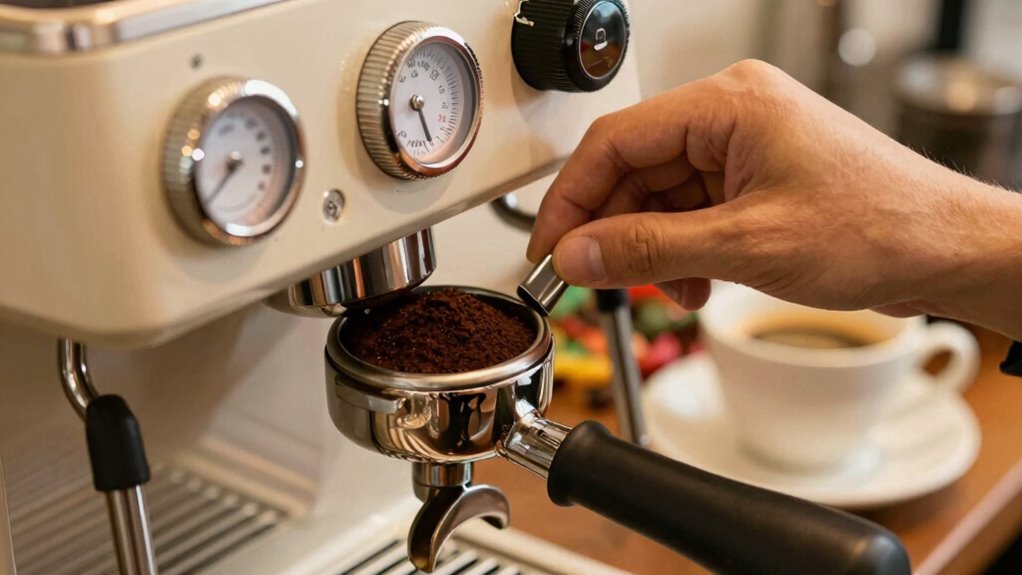
If you’ve ever struggled with dialing in the perfect espresso shot, you’re not alone. Achieving that ideal balance between flavor, crema, and extraction takes more than just good beans; it’s about mastering the variables that influence every shot. Two of the most critical factors are grind consistency and brew temperature. When either of these isn’t just right, your espresso can taste flat, sour, bitter, or under-extracted. Luckily, understanding how to control these variables puts you on the path to consistently great shots.
First, focus on grind consistency. The grind size directly affects the flow rate of water through the coffee puck. Too fine, and the shot may over-extract, resulting in a bitter taste; too coarse, and it’ll under-extract, leaving your shot sour and weak. To achieve uniform grind consistency, use a high-quality burr grinder rather than blade grinders, which produce uneven particles. Consistency in grind size ensures a steady extraction and helps you dial in your shot more predictably. Adjust the grind in small increments—about a fraction of a turn—until you notice the shot’s timing and flavor improve. Keep notes of each adjustment so you can refine your process over time. Additionally, grind uniformity is crucial for predictable results. Understanding the important role of consistency in brewing can significantly enhance your espresso quality. Developing an understanding of brew variables can further help you troubleshoot and improve your technique. Paying attention to particle size distribution can also make a noticeable difference in shot quality, especially when combined with proper tamping and shot timing.
Next, pay close attention to brew temperature. Coffee is highly sensitive to temperature fluctuations, and even slight changes can significantly impact flavor. Ideally, your espresso machine should maintain a stable brew temperature around 195-205°F (90-96°C). If your shot tastes sour or under-extracted, your water might be too cool; if bitter or harsh, it might be too hot. Many machines have temperature settings or PID controllers that let you fine-tune this variable. Consistent brew temperature ensures that your coffee’s complex flavors develop properly, leading to a balanced shot with a rich crema.
Balancing grind consistency and brew temperature is an ongoing process. Once you dial in these variables, you’ll notice your shots become more predictable and flavorful. Remember, small adjustments make a big difference, so approach each tweak methodically. Don’t forget to consider other factors like tamp pressure and shot timing, but keep these core variables front and center. With patience and attention to detail, you’ll find that dialing in espresso isn’t just about luck; it’s about understanding and controlling the variables that truly influence your shot’s quality. Developing a comprehensive understanding of brewing can help you fine-tune every aspect of your process. In doing so, you’ll consistently craft espresso that’s rich, well-balanced, and satisfying.
high-quality burr coffee grinder
As an affiliate, we earn on qualifying purchases.
As an affiliate, we earn on qualifying purchases.
Frequently Asked Questions
How Often Should I Calibrate My Espresso Grinder?
You should calibrate your espresso grinder regularly, ideally every few weeks, to maintain ideal shot quality. Focus on checking the grinder burr alignment and ensuring consistent dose measurements. If you notice uneven grinds, inconsistent extraction, or fluctuations in shot quality, it’s time for a calibration. Regular calibration helps keep dose consistency high, resulting in better flavor and a more reliable espresso experience.
What Water Temperature Is Optimal for Brewing Espresso?
You should aim for a brewing water temperature of around 195-205°F (90-96°C) for ideal espresso extraction. Maintaining water mineral content is essential, as too much or too little can affect flavor and machine performance. Ensuring brewing temperature stability helps produce consistent shots, so use a quality grinder and water source. Regularly check your equipment to keep the temperature steady, and you’ll enjoy richer, more balanced espresso every time.
How Does Ambient Humidity Affect Espresso Extraction?
Ambient humidity impacts espresso extraction by influencing moisture levels in your coffee grounds. High humidity can cause grounds to absorb excess moisture, leading to over-extraction and a bitter taste, while low humidity can result in dry grounds that under-extract, making your shot weak and sour. To maintain extraction consistency, adjust grind size or dose accordingly, especially in fluctuating humidity conditions, ensuring your espresso remains balanced and flavorful.
Can Different Coffee Bean Origins Alter Dialing-In Parameters?
Yes, different coffee bean origins can considerably modify your dialing-in parameters. You might think dialing-in is uniform, but bean origin affects grind size, dose, and extraction time because each origin has a unique flavor profile. For example, a Ethiopian bean may require a finer grind for ideal extraction, while a Colombian bean might need a slightly coarser setting. Adjusting these variables guarantees you highlight each origin’s distinct flavor profile.
What Is the Ideal Resting Time After Cleaning My Espresso Machine?
The ideal resting time after cleaning your espresso machine is about 10 to 15 minutes. This allows the machine to dry and any residual cleaning solution to evaporate, ensuring peak performance. Incorporate this pause into your cleaning routines and machine maintenance schedule to prevent flavor contamination and maintain consistent shots. Rushing this step can affect extraction quality, so always give your machine enough time to be ready for the next brew.
Conclusion
Mastering the three variables—dose, grind size, and extraction time—can dramatically improve your espresso shots. Did you know that even a 0.1mm change in grind size can alter extraction by up to 20%? By dialing in these factors, you’re not just making better coffee—you’re revealing a world of flavor and consistency. Keep experimenting, stay patient, and enjoy each perfect shot. Your taste buds will thank you!
NFL season / tailgating Picks
team gear
As an affiliate, we earn on qualifying purchases.