

To stop the boom from your subwoofer, start by avoiding corners and placing it along a wall but away from direct corners. Use the “subwoofer crawl”: place it in your listening spot and move around to find where the bass sounds tight and even. Small shifts in position can make a big difference, and experimenting with different wall distances helps smooth out uneven bass. Keep tuning and adjusting; more tips lie ahead to perfect your setup.

Get the little things that make your day delivered free — and shop member deals
- Fast, free delivery on millions of items
- Access to Prime Big Deal Days deals on October 6–7
- Prime Video, Amazon Music and more included
Key Takeaways
- Avoid placing the subwoofer directly in corners to prevent excessive bass amplification.
- Use the “subwoofer crawl”: listen for the best bass response while moving the subwoofer around.
- Position the subwoofer along a wall, but away from corners for balanced sound.
- Minimize sound reflections by experimenting with placement near soft furnishings or away from reflective surfaces.
- Fine-tune placement with calibration tools or room correction systems to eliminate boomy sounds.
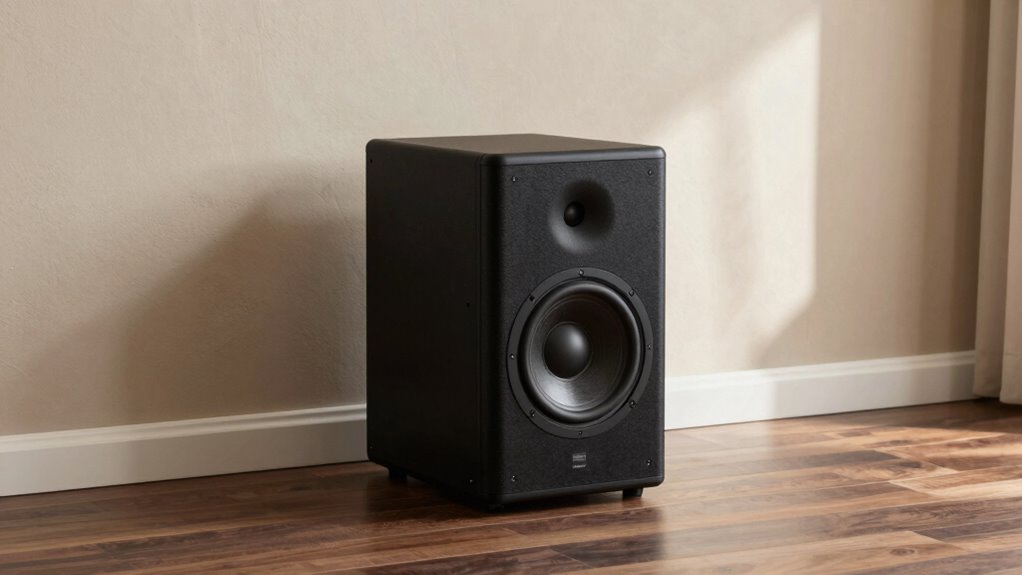
Have you ever wondered why your subwoofer sounds off or lacks depth? The answer often lies in placement. Proper subwoofer placement is crucial to achieving ideal bass response and making your audio sound full and balanced. When your subwoofer isn’t positioned correctly, it can produce uneven bass or cause annoying booms and rattles that distract from the listening experience. The key is understanding how room acoustics influence sound and how to work with them rather than against them.
Proper subwoofer placement is essential for balanced, full sound and avoiding boomy, uneven bass.
Bass response can be tricky because low frequencies tend to bounce around a room differently than higher ones. When placed poorly, your subwoofer might produce boomy or muted sounds, making it hard to enjoy movies or music. The goal is to find a spot where the bass feels natural and seamless, rather than exaggerated or muddy. To do that, you should start by avoiding corners, which tend to amplify bass too much, causing that boominess you want to eliminate. Instead, try placing the subwoofer along a wall but away from corners, and listen for a spot where the bass feels even and tight. Additionally, understanding room acoustics can help you identify how different surfaces impact sound reflection and absorption.
Room acoustics play a significant role in how your subwoofer performs. Hard surfaces like tile or glass reflect sound waves, leading to resonances and uneven bass response. Soft furnishings like curtains and carpets absorb these reflections, helping to smooth out the sound. When positioning your sub, consider these elements—placing the subwoofer in a spot that minimizes destructive interference and standing waves will give you clearer, more accurate bass. You might also experiment with the distance from walls, as small shifts can dramatically improve sound quality. Recognizing how sound reflections influence your listening environment can assist in making better placement decisions.
Another effective method is the “subwoofer crawl.” You place your subwoofer temporarily in your favorite listening spot, then crawl around the room, listening carefully to where the bass sounds best and most balanced. Once you find that sweet spot, move the subwoofer there permanently. This method ensures you’re working with your specific room’s acoustics rather than generic advice. Additionally, using a calibration tool or room correction system can fine-tune your setup further, compensating for any acoustic anomalies. Understanding room acoustics and how they affect sound can greatly enhance your ability to optimize placement.
Ultimately, the secret to stopping the boom and enhancing bass response lies in understanding your room’s acoustics and experimenting with placement. Small adjustments can make a significant difference, transforming uneven, boomy sound into a smooth, powerful bass that complements your entire audio system. With patience and a keen ear, you can optimize your subwoofer’s position for the best sound in your space.
As an affiliate, we earn on qualifying purchases.
Frequently Asked Questions
Can Subwoofer Placement Affect Overall Sound Quality?
Yes, subwoofer placement can considerably impact your sound quality. Proper placement guarantees accurate bass response, reducing muddiness or boomy sounds. Subwoofer calibration helps fine-tune the bass levels, while acoustic treatment minimizes reflections and unwanted resonances. By positioning your subwoofer carefully and calibrating it correctly, you’ll enjoy clearer, more balanced sound throughout your space, avoiding overwhelming bass and achieving a richer listening experience.
How Do Room Size and Shape Influence Subwoofer Placement?
Think of your room as a vessel for sound, where size and shape are the guiding currents. Larger rooms with unique dimensions can create unpredictable acoustic reflections, making placement tricky. Smaller or irregularly shaped spaces might amplify bass unevenly. To find harmony, adjust your subwoofer based on room dimensions, avoiding corners and reflective surfaces, ensuring sound flows smoothly, like gentle waves, rather than crashing chaos.
Is It Better to Place the Subwoofer Near Walls or in the Corner?
Placing your subwoofer in a corner generally boosts bass, but for balanced sound, try near walls instead. Keep the subwoofer at a prime height; placing it too high or low can distort sound. Also, match the subwoofer color to your room decor to avoid visual distraction. Experiment with different spots, listening carefully to find the best placement that minimizes boom and maximizes clarity.
How Do I Troubleshoot Persistent Bass Boom Issues?
To troubleshoot persistent bass boom issues, start with proper subwoofer calibration to balance the sound levels. Next, consider acoustic treatment like bass traps or diffusers to absorb or diffuse excess low frequencies. Adjust the subwoofer’s position gradually, avoiding corners if boomy. You can also use a room correction system or EQ to fine-tune the bass response, ensuring your setup minimizes boom and delivers clear, balanced sound.
Can Multiple Subwoofers Improve Sound Consistency?
Yes, multiple subwoofers can improve sound consistency by distributing bass more evenly throughout your space. To maximize their effectiveness, focus on subwoofer isolation to reduce unwanted vibrations, and perform frequency tuning to guarantee each subwoofer complements the others. Proper placement and calibration help minimize boomy spots, providing richer, more uniform bass across your room. This setup creates a balanced sound experience, avoiding the boominess caused by single subwoofers.
Conclusion
So, if you want your music to hit like a lightning bolt instead of a thunderstorm, don’t ignore your subwoofer placement. Move it around, experiment, and soon you’ll have bass so perfectly smooth it’s like velvet melting in your ears. Say goodbye to embarrassing booms and hello to flawless, wall-shaking sound that’ll make your neighbors think you’ve got a secret concert hall in your living room. Trust me, your ears—and your neighbors—will thank you!
Fall Picks
fall essentials
As an affiliate, we earn on qualifying purchases.