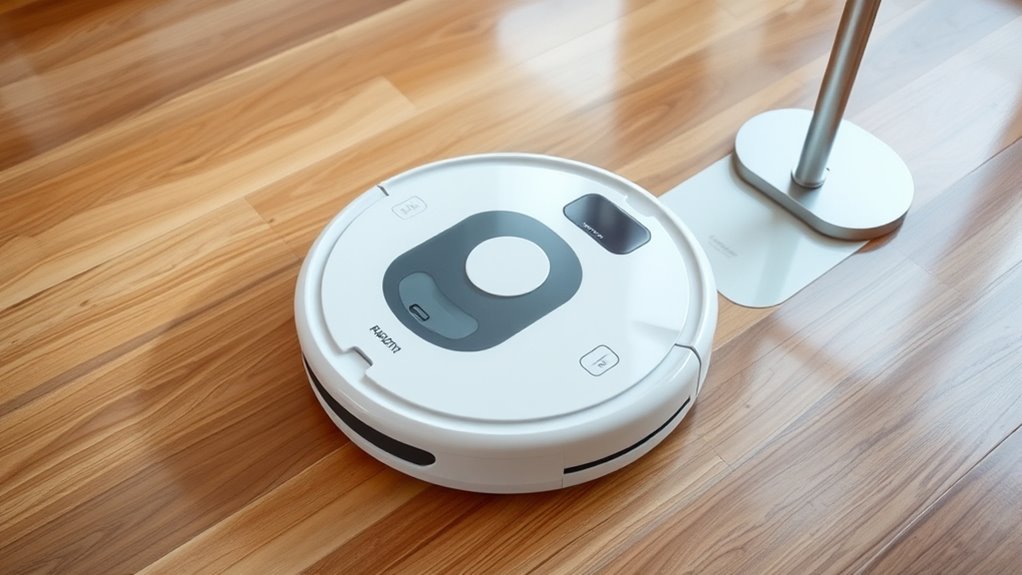

Among robotic mops with auto-cleaning bases, I rank the Dreame L40 Ultra Gen 2 as the best overall pick for buyers seeking an all-in-one cleaning station, while the Roborock Qrevo S5V stands out as a strong alternative for balanced vacuuming and mopping. The eufy Omni C20 is a compelling choice when a more compact base matters, and the iRobot options suit shoppers who prefer a simpler approach to floor care. The main tradeoff is how much convenience you want from the base versus the space, upkeep, and cost that come with a more feature-rich system. I compare all nine listings by cleaning features, dock tasks, usability, and fit for different homes below.

Get the little things that make your day delivered free — and shop member deals
- Fast, free delivery on millions of items
- Access to Prime Big Deal Days deals on October 6–7
- Prime Video, Amazon Music and more included
Complete the kit


Key Takeaways
Dock capability separates the picks: auto-emptying alone is not the same as a base that also washes or dries mop pads; check which jobs the station actually handles.
The Dreame L40 Ultra Gen 2 leads the lineup’s all-in-one positioning, while the Roborock Qrevo models provide close alternatives for buyers weighing dock features against their preferred cleaning setup.
The eufy Omni C20 makes a space-conscious case, but a smaller station may involve different compromises than larger, more feature-rich docks.
iRobot’s entries are not interchangeable: the Roomba 115 Combo with AutoEmpty Dock highlights debris handling, while the 115X and Plus 415X need closer comparison for mop and base functions.
One listing duplicates the Dreame L40 Ultra Gen 2: the roundup contains eight distinct model names across nine entries, so readers should compare the listed specifications rather than treat the repeated model as a separate design.
| eufy Omni C20 Robot Vacuum and Mop Combo, 7,000 Pa |  | Best for Low-Clearance Furniture | Suction power: Up to 7,000 Pa | Runtime: Up to 132 minutes | Height: 3.35 inches (85 mm) | VIEW ON AMAZON | See Our Full Breakdown |
| Dreame L40 Ultra Gen 2 Robot Vacuum and Mop |  | Best for Maximum Suction and Coverage | Suction power: 25,000 Pa | Battery capacity: 5,200 mAh | Battery life: Up to 231 minutes | VIEW ON AMAZON | See Our Full Breakdown |
| Roborock Qrevo S5V Robot Vacuum and Mop |  | Best for Multi-Floor Homes | Suction power: 12,000 Pa | Mop rotation speed: 200 RPM | Mop lift: 10 mm | VIEW ON AMAZON | See Our Full Breakdown |
| iRobot Roomba 115X Combo Robot Vacuum and Mop |  | Best for Simple, Targeted Mopping | Suction power: 10,000 Pa | Coverage per charge: Up to 900 sq ft | Navigation: ClearView LiDAR | VIEW ON AMAZON | See Our Full Breakdown |
| Shark Matrix Plus Robot Vacuum and Mop Combo, AV2610WA |  | Best for Bagless Debris Storage | Model: AV2610WA | Cleaning type: Robot vacuum and mop | Self-emptying capacity: Up to 60 days of dirt and debris | VIEW ON AMAZON | See Our Full Breakdown |
| iRobot Roomba Plus 415X Robot Vacuum and Mop Combo |  | Best for Pet Hair and Rug Transitions | Cleaning functions: Vacuuming and mopping | Dock: AutoWash Dock with mop-pad washing, heat drying at 113°F, debris emptying, and water refilling | Debris capacity: Up to 90 days before emptying | VIEW ON AMAZON | See Our Full Breakdown |
| iRobot Roomba 115 Combo Robot Vacuum and Mop with AutoEmpty Dock |  | Best for Simple, Low-Maintenance Upkeep | Suction: 15,000 Pa | Coverage: Up to 900 sq. ft. per charge | Navigation: ClearView LiDAR | VIEW ON AMAZON | See Our Full Breakdown |
| Dreame L40 Ultra Gen 2 Robot Vacuum and Mop |  | Best for Large Homes and Detailed Reach | Suction power: 25,000 Pa | Suction levels: 5 | Battery capacity: 5,200 mAh | VIEW ON AMAZON | See Our Full Breakdown |
| Roborock Qrevo S Pro Robot Vacuum and Mop |  | Best for Quiet, Carpet-Aware Docked Cleaning | Suction power: 18,500 Pa | Dock: Automatic dust emptying, mop washing, and mop drying | Dust bag capacity: 2.7 L | VIEW ON AMAZON | See Our Full Breakdown |
| robotic mops with auto cleaning base | Suction power | Navigation | Mop lift |
|---|---|---|---|
| eufy Omni C20 Robot Vacuum and | Up to 7,000 Pa | iPath Laser Navigation; up to 3 floor maps | — |
| Dreame L40 Ultra Gen 2 Robot V | 25,000 Pa | — | Up to 10.5 mm |
| Roborock Qrevo S5V Robot Vacuu | 12,000 Pa | LiDAR | 10 mm |
| iRobot Roomba 115X Combo Robot | 10,000 Pa | ClearView LiDAR | — |
| Shark Matrix Plus Robot Vacuum | — | 360° LiDAR mapping with object detection and avoidance | — |
| iRobot Roomba Plus 415X Robot | — | LiDAR mapping and obstacle recognition | 10 mm |
| iRobot Roomba 115 Combo Robot | — | ClearView LiDAR | — |
| Dreame L40 Ultra Gen 2 Robot V | 25,000 Pa | — | 0.41 in |
| Roborock Qrevo S Pro Robot Vac | 18,500 Pa | — | 10 mm |
More Details on Our Top Picks
eufy Omni C20 Robot Vacuum and Mop Combo, 7,000 Pa
The eufy Omni C20 earns this spot by pairing an auto-empty, mop-washing, and drying station with a notably slim 3.35-inch robot. That low profile can reach beneath furniture that may block taller options such as the Dreame L40 Ultra Gen 2, while its 7,000 Pa suction and simultaneous vacuuming and mopping cover routine mixed-floor upkeep. Automatic mop lifting helps protect carpet during a run, and the station reduces hands-on pad care after cleaning.
The tradeoff is less carpet clearance flexibility: carpets over 20 mm require No-Go Zones, and boundary strips are neither included nor compatible. Its 2.4 GHz-only Wi-Fi may also rule it out for some setups. Choose it for low furniture and automated pad care, not for a home with thick rugs or a need for stronger suction than the Roborock Qrevo S5V offers.
Pros:- Station empties dust and washes and dries mop pads
- Slim 3.35-inch body can reach beneath low furniture
- Vacuums and mops simultaneously, with automatic mop lifting on carpet
- Stores up to three floor maps
Cons:- Carpets over 20 mm require No-Go Zones
- Supports 2.4 GHz Wi-Fi only
- Boundary strips are not included or compatible
Best for: People with hard floors, low-clearance furniture, and a mix of thin rugs who want the dock to handle dust emptying and mop-pad care.
Not ideal for: Homes with carpets over 20 mm or buyers who need 5 GHz Wi-Fi support or boundary strips to block off areas.
- Suction power:Up to 7,000 Pa
- Runtime:Up to 132 minutes
- Height:3.35 inches (85 mm)
- Dust bag capacity:3.1 L
- Mop pressure and speed:6 N; 180 RPM
- Navigation:iPath Laser Navigation; up to 3 floor maps
- Connectivity:2.4 GHz Wi-Fi
- Controls:App, buttons, Amazon Alexa, and Google Assistant
Our verdict“Choose the eufy Omni C20 if its low profile and automated mop care matter more than thick-carpet handling or higher suction.”
Dreame L40 Ultra Gen 2 Robot Vacuum and Mop
For buyers who want a broad cleaning run and high suction, the Dreame L40 Ultra Gen 2 leads this group on paper with 25,000 Pa suction and up to 231 minutes of battery life. Its dock empties dust, washes the mops, and dries them with hot air, so the base does more than the charging-only setup on the iRobot Roomba 115X Combo. An extendable brush and mop help reach corners, while obstacle avoidance and five suction levels give it more tools for mixed hard-floor and carpet homes.
That capability comes with setup caveats: automatic cleaning-solution filling needs a separately purchased module, and the stated 2.4 GHz Wi-Fi support is for USA use only. Its 10.5 mm mop lift also may not provide ample clearance over every rug. Compared with the Roborock Qrevo S5V, it offers greater stated suction and longer runtime, but buyers should check connectivity and add-on needs before choosing it.
Pros:- 25,000 Pa suction with five selectable levels
- Up to 231 minutes of battery life and 1,679 sq ft stated coverage in Quiet Mode
- Dock empties dust, washes mops, and hot-air dries them
- Extendable brush and mop help clean corners
Cons:- Automatic cleaning-solution filling requires a separately purchased module
- Specified 2.4 GHz Wi-Fi support is for USA use only
- Mop lift is limited to 10.5 mm
Best for: Households with larger floor plans, mixed flooring, and frequent cleaning needs that can make use of long runtime and a feature-rich self-cleaning dock.
Not ideal for: Buyers outside the stated USA Wi-Fi use, anyone who requires automatic solution filling without buying an extra module, or homes with rugs needing more than 10.5 mm of mop clearance.
- Suction power:25,000 Pa
- Battery capacity:5,200 mAh
- Battery life:Up to 231 minutes
- Quiet Mode coverage:Up to 1,679 sq ft
- Mop lift:Up to 10.5 mm
- Suction levels:5
- Dock functions:Auto-emptying, mop washing, and hot-air drying
- Wi-Fi:2.4 GHz; USA use only
Our verdict“Pick the Dreame L40 Ultra Gen 2 for long-running, high-suction cleaning with an automated mop-care dock, provided its Wi-Fi and add-on requirements fit your setup.”
Roborock Qrevo S5V Robot Vacuum and Mop
The Roborock Qrevo S5V is a strong fit for homes with multiple levels: it stores up to four floor plans, and its app supports room targeting, schedules, and no-go zones. Its dock takes care of the less appealing routine work by emptying dust, washing and warm-air drying the dual spinning pads, and refilling the water tank. Compared with the eufy Omni C20, it offers higher stated suction and multi-floor mapping; against the Dreame L40 Ultra Gen 2, it has a lower suction figure but keeps the dock’s core mop-care functions.
The extendable mop arm and 200 RPM pads are aimed at edges and stuck-on messes, though the 10 mm lift gives only limited clearance over low-pile carpet. Wi-Fi is 2.4 GHz only, which narrows compatibility for some networks. This is the more map-focused pick for homes with several floors, rather than a choice for thick rugs or buyers prioritizing the lineup’s highest suction.
Pros:- Stores up to four floor plans for multi-level cleaning
- Dock empties dust, washes and warm-air dries pads, and refills the water tank
- Extendable mop arm and dual spinning pads help clean edges
- App supports room targeting, schedules, and no-go zones
Cons:- Supports 2.4 GHz Wi-Fi only
- 10 mm mop lift offers limited clearance over low-pile carpets
- Suction is lower than the Dreame L40 Ultra Gen 2’s stated 25,000 Pa
Best for: Owners of multi-level homes who want saved floor maps, targeted room cleaning, and a dock that manages dust, mop washing, drying, and water refills.
Not ideal for: Homes with rugs that need substantial mop clearance, or buyers whose Wi-Fi setup requires 5 GHz support.
- Suction power:12,000 Pa
- Mop rotation speed:200 RPM
- Mop lift:10 mm
- Dust storage:Up to 10 weeks
- Water tank coverage:Up to 3,552 sq ft
- Floor mapping:Up to 4 floor plans
- Navigation:LiDAR
- Obstacle avoidance:Structured light sensors
Our verdict“Choose the Qrevo S5V if saved maps for several floors and full dock-based mop care matter more than maximum suction or greater rug clearance.”
iRobot Roomba 115X Combo Robot Vacuum and Mop
The Roomba 115X Combo suits buyers who want straightforward vacuum-and-mop runs rather than a base that handles every cleanup task. ClearView LiDAR maps rooms and helps the robot avoid obstacles, while No Mop Zones give rug owners a way to keep selected areas dry. You can adjust suction, water or solution levels, and pass count, giving this model useful control without relying on the more elaborate dock workflow found on the Roborock Qrevo S5V.
The key limitation for this roundup is that its listed base is a charging dock, not an auto-cleaning base: the washable microfiber pad does not get automatically washed or dried, and the dock does not empty dust. Coverage is also listed at up to 900 sq ft per charge, below the Dreame L40 Ultra Gen 2’s stated Quiet Mode coverage. Choose it for adjustable, mapped cleaning if you are willing to handle pad care yourself; skip it if dock automation is the reason you are shopping.
Pros:- LiDAR navigation maps rooms and supports obstacle avoidance
- No Mop Zones help protect rugs
- Washable microfiber pad and adjustable suction, water, and pass settings
- Vacuums and mops in one pass
Cons:- Listed dock only charges the robot; it does not automatically empty dust or clean the pad
- Coverage is up to 900 sq ft per charge
- Requires 2.4 GHz Wi-Fi for setup
Best for: Buyers who want LiDAR-guided vacuuming and mopping, adjustable cleaning settings, and rug exclusions but are comfortable washing the pad themselves.
Not ideal for: Anyone specifically seeking a dock that automatically empties debris and washes or dries mop pads, or households needing more than 900 sq ft per charge.
- Suction power:10,000 Pa
- Coverage per charge:Up to 900 sq ft
- Navigation:ClearView LiDAR
- Mopping pad:Washable microfiber
- Cleaning modes:1–2 passes, 4 suction levels, and 3 water or solution levels
- Wi-Fi requirement:2.4 GHz for setup
- Charging:Automatically returns to dock
Our verdict“Pick the Roomba 115X Combo for mapped, adjustable cleaning if manual pad care is acceptable; choose a self-cleaning dock model for more automation.”
Shark Matrix Plus Robot Vacuum and Mop Combo, AV2610WA
The Shark Matrix Plus earns a distinct place for its bagless self-emptying base, which holds up to 60 days of dirt and debris, and its True HEPA filtration. That makes it a practical choice for buyers who want to avoid disposable dust bags while still limiting frequent bin emptying. LiDAR mapping, object avoidance, and Recharge and Resume support scheduled coverage; its sonic mop scrubs at 100 strokes per minute, while the self-cleaning brushroll is aimed at reducing pet-hair wrap. Compared with the eufy Omni C20, however, the Shark’s base is focused on dust collection rather than washing and drying mop pads.
That distinction matters in a roundup centered on auto-cleaning bases: the Shark does not automate mop-pad washing or drying, so pad maintenance stays with you. Mopping is also limited to hard floors. Choose it for bagless debris storage and filtration, not for full-service mop care like the Dreame L40 Ultra Gen 2 provides.
Pros:- Bagless base holds up to 60 days of dirt and debris
- True HEPA filtration captures 99.97% of dust and allergens down to 0.3 microns
- LiDAR mapping, object avoidance, and Recharge and Resume support automated runs
- Self-cleaning brushroll helps limit pet-hair wrap
Cons:- Base does not wash or dry the reusable mop pads
- Mopping is limited to hard floors
- Included starter cleaning solution is 12 oz.
Best for: Pet owners or dust-sensitive households who want a bagless self-emptying base, HEPA filtration, and methodical vacuuming with occasional hard-floor mopping.
Not ideal for: Buyers seeking a base that washes and dries mop pads, or anyone who needs the robot to mop carpet.
- Model:AV2610WA
- Cleaning type:Robot vacuum and mop
- Self-emptying capacity:Up to 60 days of dirt and debris
- Mopping rate:100 scrubs per minute
- Filtration:True HEPA; captures 99.97% of dust and allergens down to 0.3 microns
- Navigation:360° LiDAR mapping with object detection and avoidance
- Included mopping pads:2 reusable microfiber pads
- Included cleaning solution:12 oz. starter bottle
Our verdict“Choose the Shark Matrix Plus if bagless debris storage and HEPA filtration outrank automatic mop-pad washing and drying.”
iRobot Roomba Plus 415X Robot Vacuum and Mop Combo
The Roomba Plus 415X suits homes that need mopping and vacuuming in one run without leaving mop-pad care to the owner. Its AutoWash Dock washes and heat-dries the pads, empties debris for up to 90 days, and refills water, combining more maintenance tasks than the Roomba 115 Combo’s AutoEmpty dock, which handles debris but not mop washing. LiDAR mapping, obstacle recognition, and 10 mm mop lift help it manage mixed rooms, while tangle-free rubber brushes are a useful match for pet hair. The tradeoff is that these hands-off benefits depend on the AutoWash Dock, and the stated suction and slimmer design comparisons are against specific Roomba models rather than the other robots here. Pick it for automated mop upkeep; skip it if you mainly want a simpler debris-emptying dock.
Pros:- AutoWash Dock washes and heat-dries mop pads, refills water, and empties debris
- Vacuuming and mopping can run together
- Tangle-free rubber brushes are designed for pet hair
- Lifts mop pads 10 mm over rugs and recognizes obstacles
Cons:- The long debris-emptying interval and added dock functions depend on the AutoWash Dock
- Suction and slimmer-design claims compare it with specific Roomba models, not the full lineup
Best for: Pet owners with a mix of hard floors and rugs who want the dock to wash and heat-dry mop pads as well as empty debris.
Not ideal for: Buyers who want a basic, debris-only auto-empty setup or who need independently comparable suction figures across brands.
- Cleaning functions:Vacuuming and mopping
- Dock:AutoWash Dock with mop-pad washing, heat drying at 113°F, debris emptying, and water refilling
- Debris capacity:Up to 90 days before emptying
- Mop lift:10 mm
- Navigation:LiDAR mapping and obstacle recognition
- Suction comparison:2.3x more than Roomba 600 series
- Design comparison:46% slimmer than Roomba 105
Our verdict“Choose the Roomba Plus 415X if pet hair and automated mop-pad care matter more than a simpler auto-empty dock.”
iRobot Roomba 115 Combo Robot Vacuum and Mop with AutoEmpty Dock
The Roomba 115 Combo is the more straightforward choice for buyers who want a dock to handle debris disposal, not mop-pad washing. Its sealed 2.5 L allergen bag holds debris for up to three months, while ClearView LiDAR maps rooms and No Mop Zones give owners a way to protect rugs. Unlike the Roomba Plus 415X, its dock does not wash or dry the mop pad, so routine mop maintenance stays with you. It also lacks the Dreame L40 Ultra Gen 2’s listed extending brush and mop for reaching corners. Up to 900 sq. ft. per charge makes it a better fit for small to medium homes than large, sprawling layouts. Setup requires 2.4 GHz Wi-Fi, and the washable microfiber pad is a simpler arrangement than a dock with automated mop care.
Pros:- AutoEmpty dock stores debris in a sealed bag for up to three months
- LiDAR mapping supports multi-room navigation
- No Mop Zones help keep rugs dry
- Adjustable suction, pass count, and water settings offer cleaning control
Cons:- Coverage is listed at up to 900 sq. ft. per charge
- The dock does not wash or dry the mop pad
- Setup requires 2.4 GHz Wi-Fi, and filters and brushes need replacement every 3–6 months
Best for: People in small to medium homes who want scheduled hard-floor cleaning and sealed, hands-off debris disposal but are comfortable washing the mop pad themselves.
Not ideal for: Owners of larger homes or buyers who want the dock to wash and dry mop pads between runs.
- Suction:15,000 Pa
- Coverage:Up to 900 sq. ft. per charge
- Navigation:ClearView LiDAR
- Dock:AutoEmpty dock with sealed allergen bag
- Dust bag capacity:2.5 L; up to three months of debris storage
- Mop pad:Washable microfiber
- Cleaning settings:4 suction levels, 1–2 passes, and 3 water or solution levels
- Connectivity:2.4 GHz Wi-Fi required for setup
- Allergen filtration:Bag traps 99% of pollen and mold
Our verdict“Choose the Roomba 115 Combo for compact-home cleaning and sealed debris disposal if manual mop-pad washing is acceptable.”
Dreame L40 Ultra Gen 2 Robot Vacuum and Mop
The Dreame L40 Ultra Gen 2 is the strongest fit here for buyers who value high suction and broad coverage alongside an all-in-one self-cleaning dock. Its 25,000 Pa suction and five levels give more cleaning adjustment than the Roomba Plus 415X’s listed suction comparison, while an extending brush and mop are designed to reach corners and under furniture. Quiet Mode runs for up to 231 minutes and covers up to 1,679 sq. ft. per charge, making it better suited to larger floor plans than the Roomba 115 Combo’s listed 900 sq. ft. coverage. The dock reduces routine maintenance, but the auto-detergent dispenser is sold separately, so not every hands-off feature comes in the standard setup. Its 0.41-inch mop lift and 2.4 GHz, USA-only Wi-Fi support may also limit fit for some homes.
Pros:- 25,000 Pa suction with five selectable levels
- Extending brush and mop help reach corners and areas under furniture
- All-in-one self-cleaning dock reduces manual maintenance
- Quiet Mode offers up to 231 minutes of runtime and 1,679 sq. ft. of listed coverage
Cons:- Auto-detergent dispenser is sold separately
- Wi-Fi support is limited to 2.4 GHz and USA use
- Mop lift is 0.41 inches, which may not clear every rug
Best for: Owners of larger homes who want strong suction, extended runtime, corner reach, and an all-in-one self-cleaning dock.
Not ideal for: Buyers who require built-in automatic detergent dispensing or need Wi-Fi support beyond 2.4 GHz or outside the USA.
- Suction power:25,000 Pa
- Suction levels:5
- Battery capacity:5,200 mAh
- Quiet Mode runtime:Up to 231 minutes
- Quiet Mode coverage:Up to 1,679 sq. ft. per charge
- Mop lift:0.41 in
- Dock:All-in-one self-cleaning
- Connectivity:2.4 GHz Wi-Fi; USA use only
- Voice assistants:Alexa, Siri, and Google Home
Our verdict“Choose the Dreame L40 Ultra Gen 2 for larger homes and detailed reach, provided its Wi-Fi limits and separate detergent accessory suit your setup.”
Roborock Qrevo S Pro Robot Vacuum and Mop
The Roborock Qrevo S Pro balances mop care, carpet handling, and a low listed noise level. Its dock empties dust into a sealed bag, then washes and dries the mops; at 167°F for washing and 113°F for drying, it is built to handle more mop maintenance than the Roomba 115 Combo’s debris-only dock. Carpet-aware modes, adjustable water flow, and 10 mm mop lift give it practical flexibility across mixed flooring, while anti-tangle brushes can reduce hair wrap. The 3.8-inch robot height may help it reach under some low furniture, though actual clearance depends on the space. Its 18,500 Pa suction is below the Dreame L40 Ultra Gen 2’s 25,000 Pa figure, so buyers prioritizing the highest listed suction should compare those models closely. Wi-Fi is limited to 2.4 GHz.
Pros:- Dock empties dust and washes and dries the mops
- Carpet-aware modes and 10 mm mop lift support mixed flooring
- Anti-tangle brush system helps reduce hair wrap
- Listed noise level is 55 dB, and robot height is 3.8 inches
Cons:- Wi-Fi support is limited to 2.4 GHz
- Listed suction is lower than the Dreame L40 Ultra Gen 2’s 25,000 Pa
- Dust bag duration is listed at 7–9 weeks, shorter than the Roomba 115 Combo’s stated interval
Best for: Households with a mix of carpet and hard floors that want automatic dust emptying, mop washing and drying, and a low listed operating noise.
Not ideal for: Buyers who need 5 GHz Wi-Fi or who are choosing mainly by the highest listed suction figure.
- Suction power:18,500 Pa
- Dock:Automatic dust emptying, mop washing, and mop drying
- Dust bag capacity:2.7 L
- Dust bag duration:7–9 weeks
- Mop self-cleaning temperature:167°F
- Mop drying temperature:113°F
- Mop lift:10 mm
- Robot height:3.8 in
- Noise level and Wi-Fi:55 dB; 2.4 GHz only
Our verdict“Choose the Qrevo S Pro if you want a mop-washing dock and carpet-aware cleaning, and its 2.4 GHz Wi-Fi limit fits your network.”

How We Picked
I compared the nine listings through the specific promise in this roundup: how much routine work the robot and its base can take off the owner’s hands. The main criteria were the base’s stated tasks, mop-pad care, debris handling, vacuum-and-mop versatility, and how clearly the product is suited to everyday floor maintenance. I also weighed practical fit, including dock footprint and the amount of ongoing attention a system may still need.
The order favors models whose robot and base make a convincing combined floor-care system, rather than treating suction claims or an auto-empty function as proof of a complete mop solution. I distinguish premium automation from space-conscious and simpler alternatives, and account for the different emphasis of the iRobot listings. The Dreame L40 Ultra Gen 2 appears twice in the supplied lineup; I treat those entries as the same named model, not as evidence of two distinct options. Buyers should confirm the exact dock functions and included components for the specific listing they plan to purchase.
Factors to Consider When Choosing Robotic Mops With Auto Cleaning Base
An auto-cleaning base can mean very different things from one robot to another. I would start by identifying which chores you want the station to handle, then match those functions to your floors, storage space, and tolerance for upkeep.
Check What “Auto-Cleaning” Means
Do not assume every base cleans the mop pads just because it is described as an auto-cleaning dock. Some stations focus on collecting vacuum debris; others add mop washing, drying, or water handling. Those tasks reduce different kinds of work, so list the jobs you actually want to avoid before comparing model names. A dock that empties dust but leaves pad washing to you may be a poor match for frequent mopping. At the same time, a station with more automated care can bring extra components and maintenance. Verify the functions in the exact product listing, especially when closely named versions appear.
Match the Mop to Your Floors
Think about the surfaces the robot will clean most often, not only the total floor area. Homes with broad hard-floor zones may benefit more from regular mop-pad care, while carpet-heavy layouts may put greater value on reliable vacuuming and sensible mop handling. Check whether the robot can avoid wetting rugs or whether you will need to set no-mop zones or move rugs yourself. A multi-function robot can save device space, but it may not replace a dedicated vacuum for every household. If your floors include delicate materials, check the manufacturer’s care guidance before choosing a mop system. The right balance depends on how often you want to mop and how much manual preparation you will tolerate.
Budget for Dock Space and Upkeep
A more capable base needs a place to live, plus room to access its tanks, bags, and service parts. Measure the intended spot and allow clearance for opening or removing components instead of measuring only the dock’s footprint. Also plan for recurring chores: automated stations still need attention to water, dirty-water containers, filters, brushes, and mop parts. A smaller or simpler dock can suit a tight home, but may shift more work back to you. Buyers sometimes focus on how often the robot runs and overlook how awkward routine station care can become. Choose a base that fits both your floor plan and your willingness to maintain it.
Decide Whether Vacuuming or Mopping Leads
Combo robots divide their effort between two jobs, and not every household needs equal strength in both. If dust, crumbs, and pet hair are the main concern, prioritize the vacuum system and how the base handles collected debris. For kitchens and other hard-floor zones, pay closer attention to mop design and pad-care functions. A headline suction figure alone cannot tell you how well a robot handles corners, mixed flooring, or routine navigation. Consider whether you want one machine to handle daily maintenance or expect it to replace deeper cleaning. This choice can narrow the field more effectively than comparing a long list of features.
Choose Automation You Will Actually Use
App controls, schedules, room selection, and map settings can make a robot easier to fit into a household routine, but extra controls are useful only if they are clear and dependable. Before buying, think about who will set it up and whether several people need to manage it. A simpler model may be easier to start using, while a feature-rich system can offer more control over different rooms and cleaning routines. Check which settings are available on the specific model rather than assuming every product in a family has the same software features. Also consider how often your layout changes, since frequent furniture moves or closed doors can affect planned cleaning. Choose the level of control that solves real household problems, not the longest feature list.
Frequently Asked Questions
Does an auto-empty dock also wash and dry the mop pads?
No. Auto-emptying usually refers to transferring collected vacuum debris into the dock, while mop-pad washing and drying are separate functions. Product names can make stations sound more capable than their listed tasks, so check each function individually. Also confirm whether the robot has a mop-washing station or only a debris bin at its base. If avoiding hand-washing pads is your priority, do not treat auto-emptying as a substitute.
Is a robot mop with a large, feature-rich base worth the extra space?
It can be a good fit if you want the station to take on several recurring chores and have a suitable place for it. A larger dock may need access for tank and bag changes, so the footprint is only part of the space requirement. If the robot will run rarely or your home has little hard flooring, added automation may not save enough effort to justify that setup. Compare which tasks the dock automates with the maintenance it still requires. A compact or simpler station may suit a smaller home better.
What should I prioritize if my home has both rugs and hard floors?
Start by checking how the robot handles rugs during a mopping run, since wetting a rug can undermine the convenience of a combo machine. Look for clearly stated rug detection, mop-lifting behavior, or map controls that let you set no-mop areas. Then consider how much of your home is hard flooring and whether pad care will matter for your usual schedule. A home with mostly rugs may benefit more from vacuum-focused debris handling than from elaborate mop-station features. If rugs move often, account for the extra manual map or boundary adjustments you may need.
Should I choose a combo robot or separate vacuum and mop machines?
A combo robot is a practical choice when you want one device to handle routine floor maintenance and its base supports the chores you want to automate. Separate machines can make more sense if your home has demanding carpet needs, specialized flooring, or a preference for dedicated cleaning tools. Combo models may also require compromises around switching between wet and dry tasks or preparing rooms for mopping. Compare the day-to-day routine you want, rather than assuming one machine is always more convenient. The lineup’s mix of dock types makes that question especially relevant: base functions vary even among combo robots.
Why does the roundup include two Dreame L40 Ultra Gen 2 entries?
The supplied product list names the Dreame L40 Ultra Gen 2 twice, so those entries do not represent two distinct model designs based on the information provided. I treat them as one model when describing what separates the lineup. If the two listings differ in bundle contents, regional configuration, or included accessories, compare those details directly before choosing. Do not assume a repeated listing has different cleaning performance without evidence of a model or configuration difference. This also means the roundup covers fewer than nine distinct named models.
Conclusion
For the best overall fit, I would start with the Dreame L40 Ultra Gen 2 if you want a more automated all-in-one floor-care setup. For balanced alternatives, compare the Roborock Qrevo S5V and Qrevo S Pro by the exact dock functions and configuration in their listings. For a space-conscious choice, look at the eufy Omni C20; for a simpler starting point, compare the iRobot Roomba 115X Combo and Plus 415X based on the specific mop and base tasks they provide. For debris-first needs, the Roomba 115 Combo with AutoEmpty Dock is the iRobot listing to examine closely, while the Shark Matrix Plus adds another combo option to compare against your floor layout. The Dreame listing is duplicated, so verify the model and bundle before treating it as another choice. My final recommendation: choose by the chores the base truly automates, then make sure its size and maintenance fit your home.
Fall Picks
fall essentials
As an affiliate, we earn on qualifying purchases.