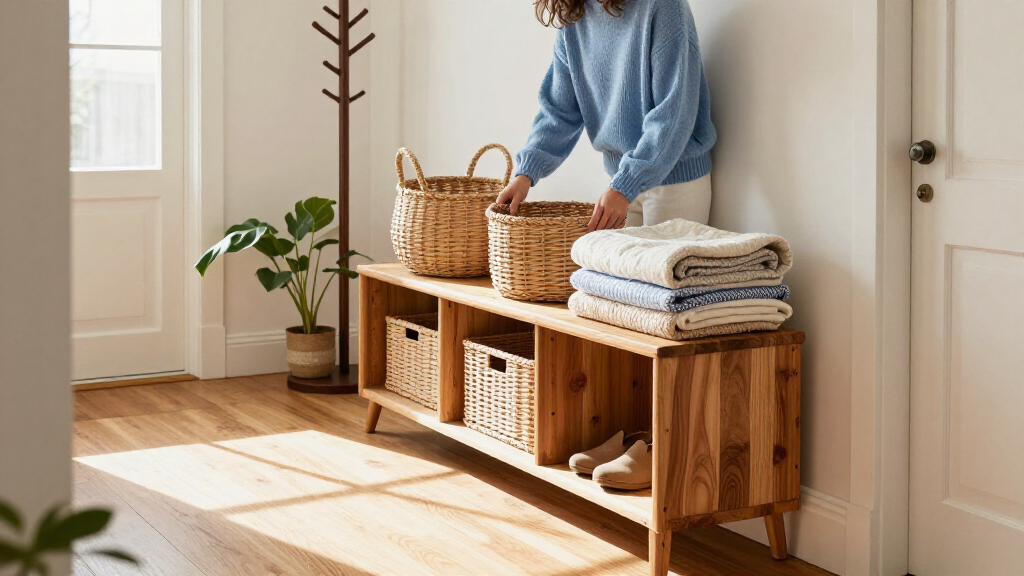

Organize one room, closet, or problem area by sorting its belongings, choosing storage that fits the space, and setting up clear places for items you use. This beginner guide is for anyone who wants a practical system without buying containers before knowing what is needed. Allow about 2–4 hours for a small area; a pantry, garage, or whole room may take longer.

Get the little things that make your day delivered free with Prime
- Fast, free delivery on millions of items
- Prime Video, Amazon Music and more included
- Member-only deals all year

VNVTO 4-Tier Stackable Storage Bin with Lid, Front Door, and Wheels
- ✔ Total capacity: 284 gallons (1136 QT)
- ✔ Number of tiers: 4
- ✔ Dimensions: 65.28 in H × 29.53 in L × 19.69 in W

SAILUN Stackable Storage Cabinet with Lid, 5 Compartments, Black
- ✔ Dimensions: 26 × 17 × 71 in
- ✔ Capacity: 543 liters
- ✔ Weight: 13.13 kg

Deco Brothers Stackable Under-Sink Organizer with Sliding Basket, Chrome
- ✔ Brand: Deco Brothers
- ✔ Model: BK-020-1
- ✔ Material: Metal
Difficulty: Beginner | Time: 2–4 hours per small area; add time for larger rooms
What You’ll Need
Tools & Materials:
- Tape measure
- Pencil and paper or a notes app
- Cleaning cloth and household cleaner
- Boxes or bags for items to keep, relocate, donate, or discard
- Labels and a marker
- Storage containers, baskets, hooks, or drawer dividers chosen after sorting
Knowledge:
- Basic measuring
- Ability to decide which belongings are used, needed, or ready to leave
Start with one defined area, such as a single closet, pantry shelf, or entryway. Set aside a clear surface for sorting. Check household rules before discarding electronics, medication, batteries, or other items that need special disposal.
VNVTO 4-Tier Stackable Storage Bin with Lid, Front Door, and Wheels
For a household that needs to contain bulky or seasonal belongings in one vertical footprint, VNVTO is the most complete option in this lineup. Its stated 284-gallon total capacity is paired with four tiers, clear panels, a top lid, and a front opening door. That combination can make it easier to identify and retrieve items without unloading everything above them, a practical advantage over a simple lidded container.The wheels also make the tall unit easier to reposition, and two locking brakes help keep it in place after moving. Compared with SAILUN, VNVTO emphasizes large-volume, visible storage and multiple access points rather than five separately defined compartments with a stated weight limit. Its foldable construction and stackable side latches can help with setup and storage flexibility, but buyers should check the listed 65.28-inch height against their ceiling and intended location.There is a notable planning detail: only one lid is included per set, and extra lids are sold separately. The available information also does not specify a per-tier weight limit, so we would avoid assuming that every shelf suits heavy loads. Choose this model for numerous lighter or mixed household items that benefit from visibility and access; skip it if you need a rigid cabinet for heavy objects or covered lids for every tier out of the box.
Pros:
- Four tiers provide substantial stated combined capacity.
- Clear panels plus top and front access make contents easier to locate and retrieve.
- Four casters support movement, with two locking brakes to help secure the unit.
- Foldable design and stackable side latches offer storage and configuration flexibility.
Cons:
- Only one lid comes with each set; additional lids are sold separately.
- Its nearly 65-inch height needs careful clearance planning, and no per-tier load limit is listed.
Best for: Households organizing bulky, seasonal, or mixed belongings that benefit from tall, wheeled storage with front access.
Not ideal for: People storing heavy items, needing a rigid furniture-like cabinet, or expecting every tier to arrive with its own lid.
Bottom line: VNVTO is our strongest all-around choice when high capacity, visibility, and rolling access matter more than a fully rigid build or a lid on every tier.
“VNVTO is our strongest all-around choice when high capacity, visibility, and rolling access matter more than a fully rigid build or a lid on every tier.”
SAILUN Stackable Storage Cabinet with Lid, 5 Compartments, Black
SAILUN is the lineup’s compartment-led choice. Its five separate bins give us a straightforward way to sort belongings by room, person, or purpose, which can be more useful than VNVTO’s larger, tier-based capacity when the priority is keeping categories apart. At 71 inches tall, it also makes use of vertical space, while built-in wheels let the cabinet move around the home without adding separate casters.The cabinet arrives assembled, and its water-resistant polypropylene surface is described as easy to clean. Rounded edges and safety-lock buckles are useful design considerations in a household with children, though they do not replace thoughtful placement or supervision. In contrast with VNVTO’s top-and-front access and clear panels, SAILUN’s selling point is simple, divided storage; the supplied description does not specify see-through compartments or a front-door arrangement.We should pay close attention to the 22-pound maximum per bin. That limit makes this a better match for clothing, toys, linens, and other moderate-weight items than books, tools, or dense supplies. Its lightweight construction helps with portability but may feel less substantial than rigid furniture. Pick SAILUN when sorting and easy relocation are central; choose VNVTO for greater stated total capacity and more explicit access features, or Deco Brothers when the storage problem is confined to the space below a sink.
Pros:
- Five compartments help separate belongings by category or household member.
- Built-in wheels support flexible placement around the home.
- Water-resistant polypropylene is easy to clean.
- No assembly is required; rounded edges and safety-lock buckles are included.
Cons:
- Each bin has a maximum load of 22 pounds, limiting heavy-item use.
- Lightweight plastic construction may feel less sturdy than rigid furniture.
Best for: Households that want five distinct places for lighter belongings and a wheeled cabinet that arrives ready to use.
Not ideal for: Anyone organizing heavy items, seeking rigid furniture construction, or needing a compact under-sink organizer.
Bottom line: SAILUN makes the most sense when we value ready-to-use, divided storage for lighter belongings over maximum capacity or a rigid cabinet feel.
“SAILUN makes the most sense when we value ready-to-use, divided storage for lighter belongings over maximum capacity or a rigid cabinet feel.”
Deco Brothers Stackable Under-Sink Organizer with Sliding Basket, Chrome
Deco Brothers is the specialized pick in a lineup otherwise dominated by tall storage. At 16.7 inches deep, 10.8 inches wide, and 10.2 inches high, it is designed for a small cabinet interior, where fixed shelves can leave supplies hard to reach. The sliding basket brings stored items forward, reducing the need to move bottles aside just to find something at the back.That focused design makes this organizer more relevant beneath a sink than either VNVTO or SAILUN, whose tall wheeled formats serve a different kind of household storage. Its metal construction gives it a sturdier character than the plastic bin systems, and assembly does not require drilling or power tools. A second unit can stack to add another level, but that requires buying a second set, so expansion is not included in the base configuration.Our tradeoff is clear: this is not a general-purpose storage cabinet and its single unit offers far less total storage than the other two picks. The chrome-painted finish may also be less suited to buyers who want a concealed, matching cabinet interior, and we should measure around plumbing before choosing any under-sink organizer. Select Deco Brothers when access to cleaning or bathroom supplies is the problem to solve; for overflow storage elsewhere, VNVTO or SAILUN is a better fit.
Pros:
- Sliding basket brings stored items forward for easier access.
- Metal construction offers a sturdier alternative to the plastic storage systems.
- Can stack with a second unit to add storage levels.
- Assembles without drilling or power tools.
Cons:
- A second set must be purchased separately to create a stacked arrangement.
- Its compact, specialized footprint cannot replace the larger capacity of VNVTO or SAILUN.
Best for: People who need easier access to bottles and supplies inside a cramped under-sink cabinet.
Not ideal for: Buyers seeking high-volume, whole-room storage or a multi-compartment rolling cabinet.
Bottom line: Deco Brothers is the right choice when under-sink access is the specific challenge, even though it cannot serve as a general storage solution.
“Deco Brothers is the right choice when under-sink access is the specific challenge, even though it cannot serve as a general storage solution.”
As an Amazon Associate we earn from qualifying purchases.
Before You Start
Set a spending limit and avoid buying storage products until you know what will remain. Measure the available floor, shelf, drawer, and cabinet space, including depth and height. Leave a clear walkway and keep heavy items low. If you are organizing a shared area, agree on what belongs there and how items will be grouped.
Step-by-Step Instructions
Step 1: Choose one area and define its purpose
Pick a manageable area and write down what it needs to store and how you use it. For a front hall, that might mean everyday shoes, bags, keys, and seasonal accessories. For a pantry, list the food categories and supplies you reach for most often. Keep the project boundary specific so sorting does not spread through the whole home.
Tip: Choose an area that causes daily friction, such as a crowded counter or a closet where items get lost.
Check: You can describe the area’s purpose in one sentence and identify the belongings that belong there.
Step 2: Empty the area and clean it
Remove the items from the selected shelves, drawers, or floor and place them on your sorting surface. Wipe the empty surfaces and let them dry before putting anything back. If you are working in a large area, clear one section at a time so belongings stay manageable.
Tip: Do not pile items where they block exits or create a trip hazard.
Check: The selected storage area is empty, clean, and ready to measure.
Step 3: Sort belongings into clear groups
Make separate groups for items to keep here, relocate elsewhere, donate or give away, and discard. Check dates and condition where relevant, such as pantry goods or damaged clothing. Keep only items that serve the area’s purpose. Put decisions you cannot make in a small review box with a date to revisit, rather than letting them return to the shelves.
Tip: Do not keep duplicates in the area simply because there is room; decide how many you actually use.
Check: Every item has a destination, and the keep group contains only belongings that belong in this area.
Step 4: Measure the storage space and kept items
Measure shelf width, height, and depth, along with drawer interiors and any floor space intended for bins. Note obstructions such as hinges, pipes, sloped ceilings, or doors that swing inward. Estimate how much space each kept group needs, and write down the measurements before shopping or reusing containers.
Tip: Check the product’s inside dimensions when available; outside dimensions alone may not show whether bulky belongings will fit.
Check: You have written measurements for the usable space and know which item groups need storage.
Step 5: Assign each group a convenient location
Place frequently used belongings between waist and eye level or near the point where you use them. Put occasional and seasonal items higher, farther back, or in less accessible storage. Keep heavy objects low and leave enough space to remove containers without shifting a stack. Group similar items together, such as baking supplies, cleaning cloths, or cold-weather accessories.
Tip: Keep items used together in the same zone, such as lunch containers beside reusable bottles.
Check: Each group has a planned location that matches how often and where you use it.
Step 6: Choose storage that fits the job
Use open bins or baskets for items you grab often, lidded containers for dust-sensitive or seasonal belongings, dividers for drawers, and hooks for suitable bags or tools. Match each product to your measurements and the item group’s size. Prefer containers that are easy to lift and clean. Reuse suitable boxes or baskets before purchasing more, and do not force items into a container that strains the lid or blocks access.
Tip: Transparent containers help when contents vary; opaque containers work well when labels remain visible.
Check: Each chosen container fits the space, holds the intended group, and can be reached safely.
Step 7: Put belongings away and label storage
Place items in their assigned zones, keeping everyday belongings accessible and heavier objects on lower shelves. Avoid packing containers so tightly that items are hard to remove. Add a short label to each bin, drawer, or shelf, such as “batteries,” “guest towels,” or “pasta and rice.” Use labels that can be changed if the system needs adjustment.
Tip: For shared spaces, use plain category labels everyone in the household will understand.
Check: You can identify where each group belongs without opening several containers or moving other items.
Step 8: Test the setup with a normal routine
Use the area as you normally would: take out a frequently used item, return it, and reach for something stored less often. Notice whether doors and drawers open fully and containers slide or lift out without a struggle. Adjust locations or container sizes where the routine feels awkward, then make sure relocated and discard items leave the work area.
Tip: A storage plan should support putting things away as well as finding them.
Check: Everyday items are easy to reach and return, and no container blocks access to another.
Common Mistakes to Avoid
- Buying a large set of containers before sorting and measuring. — Sort first, measure usable space, then choose only the sizes and quantities the kept items need.
- Putting frequently used belongings on high or hard-to-reach shelves. — Reserve easy-to-reach locations for daily items and place seasonal or occasional belongings farther away.
- Using labels that are vague or no longer match the contents. — Label by clear category and update the label whenever the contents or purpose changes.
- Filling every shelf and container to capacity. — Leave room to remove items and return them without rearranging the whole area.
Troubleshooting
Problem: The containers you bought do not fit the shelves.
Solution: Recheck the usable interior width, depth, and height, including obstructions. Exchange or repurpose the containers if possible, and select products using the measured interior space.
Problem: The area still looks crowded after organizing.
Solution: Review the keep group for duplicates or belongings that belong elsewhere. Remove items that do not support the area’s purpose, then reassess whether the categories need a different layout.
Problem: Family members return things to the wrong place.
Solution: Simplify the categories, put frequently used items at convenient heights, and use clear labels. Ask household members to try the system and adjust locations they find inconvenient.
Problem: Small belongings disappear inside a large bin.
Solution: Add a smaller open container or divider within the bin, or move the items into a shallow drawer organizer. Label the group so it remains easy to find.
What Success Looks Like
The area has a clear purpose, belongings are grouped by use, and each group has a labeled place that fits the available space. Frequently used items are easy to access and return, heavy items sit low, and containers can be removed without shifting a pile. The setup works during an ordinary routine and leaves a clear path to shelves, drawers, and doors.
Next Steps
Spend a few minutes each week returning misplaced items and removing packaging or belongings that no longer belong in the area. Recheck labels and storage choices after routines change or seasons turn. Use the same process for the next problem area, one section at a time, and wait until sorting and measuring are complete before buying additional storage.
Frequently Asked Questions
Should I buy matching storage containers?
Matching containers can make shelves look consistent, but fit and access matter more. Choose sizes that suit the space and contents. A mix of baskets, dividers, and bins may work better than one uniform set.
How much empty space should I leave?
Leave enough room to lift out containers, return items, and reach what is behind them. The right amount varies by shelf and routine; avoid packing belongings so tightly that one small item requires a full rearrangement.
What should I store in clear versus opaque containers?
Use clear containers when seeing the contents helps you choose quickly. Use opaque containers for items that benefit from reduced light or visual simplicity, and place a readable label on the front.
How can I organize a small home without adding bulky furniture?
Use existing vertical space with suitable hooks or shelf dividers, organize drawers with compact inserts, and store occasional items in measured under-bed containers. Keep walkways and doors clear, and avoid adding products that make access harder.
Halloween Picks
halloween
As an affiliate, we earn on qualifying purchases.