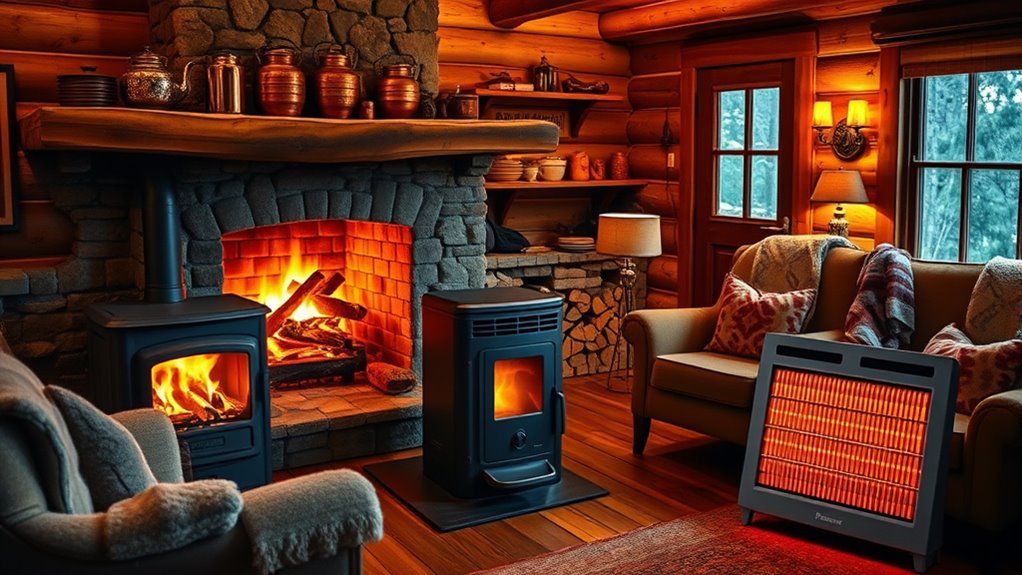

A backup heating system for cabins has one job: keep pipes from freezing and the space livable when your primary heat source fails or you arrive to a cold building on a winter weekend. After comparing vent-free propane, kerosene, natural gas and diesel options side by side, the Mr. Heater 20,000 BTU Vent-Free Blue Flame Dual Fuel Heater stands out as the best overall pick because it runs on either propane or natural gas, heats a genuinely cabin-sized space, and mounts on the wall where it cannot be knocked over. For smaller cabins or occasional use, the Mr. Heater 9,000 BTU Portable Buddy is the easiest entry point, while the self-powering diesel heater is the strongest choice for true off-grid setups where electricity is unreliable. The main tradeoffs in this category come down to fuel availability, ventilation requirements, and whether you want a permanent installation or something you can throw in the truck. Read on for the full breakdown, including which heaters should never be left running overnight.

Get the little things that make your day delivered free with Prime
- Fast, free delivery on millions of items
- Prime Video, Amazon Music and more included
- Member-only deals all year
Key Takeaways
- Dual-fuel capability separated the winners. The Mr. Heater 20,000 BTU Blue Flame earned the top spot because it runs on propane or natural gas, letting owners switch fuel sources based on what is available during an outage.
- Non-electric kerosene heaters dominated the budget tier. The 9,000 BTU 2-in-1 kerosene stove models all clustered at the value end, trading heat output and refinement for independence from any power source.
- Every vent-free heater in this lineup carries the same built-in compromise — no chimney or flue needed, but moisture and combustion byproducts stay in the room, which matters more in a tightly sealed cabin than in a drafty workshop.
- Portability and permanence split the lineup roughly in half. Wall-mounted blue flame units suit cabins you return to regularly, while portable Buddy and kerosene heaters suit owners who want one heater to serve cabin, garage and camping duty.
- Diesel and gasoline heaters are the premium off-grid answer — the Wolf 6000AW and self-powering diesel unit are the only picks here that deliver thermostatic, sustained heat without grid power, but at higher cost and installation complexity.
| Mr. Heater 20,000 BTU Vent-Free Blue Flame Dual Fuel Heater |  | Best Overall | Heating Capacity: 20,000 BTU/hr | Coverage Area: Up to 700 sq. ft. | Fuel Type: Dual LP/NG (Liquid Propane / Natural Gas) | VIEW ON AMAZON | See Our Full Breakdown |
| 9000 BTU Portable Kerosene Heater, 2 in 1 Non Electric Stove |  | Best for Heat Plus Cooking | Heating Capacity: 9,000 BTU (2600W) | Coverage Area: Approx. 15 square meters | Fuel Type: Kerosene | VIEW ON AMAZON | See Our Full Breakdown |
| Dyna-Glo 20,000 BTU Natural Gas Blue Flame Vent Free Wall Heater (BF20NMDG) |  | Best for Natural Gas Cabins | Model: BF20NMDG | Fuel Type: Natural Gas (no fuel conversion permitted) | Heat Output: 10,000–20,000 BTU/hr | VIEW ON AMAZON | See Our Full Breakdown |
| Mr. Heater 9,000 BTU Portable Buddy Radiant Propane Heater |  | Best Portable Pick | Heat Output: 4,000–9,000 BTU/hr | Fuel Type: Propane (1-lb or 20-lb cylinders) | Heating Coverage: 225 sq ft | VIEW ON AMAZON | See Our Full Breakdown |
| Mr. Heater 18,000 BTU Big Buddy PRO Series Portable Propane Heater |  | Best High-Capacity Portable | Max Heat Output: 18,000 BTU | Heat Settings: Low / Medium / High (4,000 / 9,000 / 18,000 BTU) | Coverage Area: Up to 450 sq ft | VIEW ON AMAZON | See Our Full Breakdown |
| Propane Heater Indoor and Outdoor, 18000 BTU Radiant Cabinet Heater with ODS & Tip-over Protection |  | Best Budget Backup for Mid-Size Rooms | Heat Output: 6,000–18,000 BTU (3 settings) | Heating Coverage: Up to 450 sq. ft. | Fuel Type: Liquid propane (20 lb cylinder) | VIEW ON AMAZON | See Our Full Breakdown |
| Wolf 6000AW Dual Air & Water Heater – 6kW Gasoline Heating System |  | Best Premium Integrated System | Heat Output: 6 kW (~20,500 BTU) | Function: Dual air and water heating | Fuel Type: Gasoline (off-grid) / 120VAC electric backup | VIEW ON AMAZON | See Our Full Breakdown |
| YeloDeer Self-Powering Mobile Diesel Heater 1-4KW, No Power Outlet Needed |  | Best for Deep Off-Grid and Extreme Cold | Heat Output: 1–4 kW (3,400–13,600 BTU/h) | Power Source: Diesel with self-generating thermoelectric system | Startup Power: Built-in UL-recognized rechargeable batteries | VIEW ON AMAZON | See Our Full Breakdown |
| 9000 BTU Portable Kerosene Heater, 2-in-1 Non-Electric Indoor Stove |  | Best Dual-Purpose Value for Small Cabins | Heating Capacity: 9,000 BTU (2600W) | Coverage Area: Up to ~15 square meters | Fuel Tank Capacity: 4.5L kerosene | VIEW ON AMAZON | See Our Full Breakdown |
| 9000 BTU Portable Kerosene Heater, 2-in-1 Non-Electric Indoor Stove (Adjustable Guard) |  | Best Refined Kerosene Pick | Heating Capacity: 9,000 BTU (2600W) | Coverage Area: Up to 15 square meters | Fuel Tank Capacity: 4.5L kerosene | VIEW ON AMAZON | See Our Full Breakdown |
| Mr. Heater 10,000 BTU Blue Flame Propane Vent-Free Heater |  | Best Set-and-Forget Backup for Small Cabins | Heat Output: 10,000 BTU | Fuel Type: Liquid Propane | Heating Coverage: 250 sq ft | VIEW ON AMAZON | See Our Full Breakdown |
| 9000 BTU Portable Kerosene Heater, 2 in 1 Non Electric Stove |  | Best Dual-Purpose Emergency Heater | Heat Output: 9,000 BTU (approx. 2600W) | Fuel Type: Kerosene | Heating Coverage: Approx. 15 square meters | VIEW ON AMAZON | See Our Full Breakdown |
| backup heating system for cabin | Fuel Type | Heat Output | Coverage Area |
|---|---|---|---|
| Mr. Heater 20,000 BTU Vent-Fre | Dual LP/NG (Liquid Propane / Natural Gas) | — | Up to 700 sq. ft. |
| 9000 BTU Portable Kerosene Hea | Kerosene | — | Approx. 15 square meters |
| Dyna-Glo 20,000 BTU Natural Ga | Natural Gas (no fuel conversion permitted) | 10,000–20,000 BTU/hr | Up to 700 sq. ft. |
| Mr. Heater 9,000 BTU Portable | Propane (1-lb or 20-lb cylinders) | 4,000–9,000 BTU/hr | — |
| Mr. Heater 18,000 BTU Big Budd | — | — | Up to 450 sq ft |
| Propane Heater Indoor and Outd | Liquid propane (20 lb cylinder) | 6,000–18,000 BTU (3 settings) | — |
| Wolf 6000AW Dual Air & Water H | Gasoline (off-grid) / 120VAC electric backup | 6 kW (~20,500 BTU) | — |
| YeloDeer Self-Powering Mobile | — | 1–4 kW (3,400–13,600 BTU/h) | — |
| 9000 BTU Portable Kerosene Hea | — | — | Up to ~15 square meters |
| 9000 BTU Portable Kerosene Hea | — | — | Up to 15 square meters |
| Mr. Heater 10,000 BTU Blue Fla | Liquid Propane | 10,000 BTU | — |
| 9000 BTU Portable Kerosene Hea | Kerosene | 9,000 BTU (approx. 2600W) | — |
More Details on Our Top Picks
Mr. Heater 20,000 BTU Vent-Free Blue Flame Dual Fuel Heater
This model earns the top spot because it solves the two problems that sink most cabin backup plans: fuel rigidity and electrical dependence. Dual-fuel compatibility means you can plumb it into a natural gas line at a year-round cabin, or run it off propane tanks at an off-grid property — a flexibility the Dyna-Glo BF20NMDG explicitly forbids. The built-in adjustable thermostat is another edge over the Dyna-Glo’s manual knob: set it and walk away instead of waking up at 3 a.m. to a sauna. With 20,000 BTU covering up to 700 sq. ft. and battery-powered ignition, it keeps working through a power outage, which is the whole point of backup heat. The tradeoff is inherent to vent-free design: combustion happens in your living space, so you need to keep a window cracked and stay attentive to oxygen levels, and wall mounting is more involved than dropping a portable unit on the floor.
Pros:- Dual fuel flexibility — runs on propane or natural gas depending on your setup
- Thermostatic control holds temperature without manual babysitting
- No electricity required, with battery-powered spark ignition for outages
- Vent-free design avoids the cost and complexity of installing a chimney or flue
Cons:- Vent-free combustion requires attention to room ventilation and oxygen levels
- Wall-mounted installation is a permanent commitment, not a grab-and-go solution
Best for: Owners of small-to-medium cabins (up to 700 sq. ft.) who want a permanent, set-and-forget backup that runs through power outages on either propane or natural gas
Not ideal for: Renters or people in tight, poorly ventilated spaces who can’t crack a window or drill into walls for mounting
- Heating Capacity:20,000 BTU/hr
- Coverage Area:Up to 700 sq. ft.
- Fuel Type:Dual LP/NG (Liquid Propane / Natural Gas)
- Ignition:Battery-operated electronic spark ignition (battery included)
- Thermostat:Built-in adjustable
- Venting:Vent-free, no outdoor venting required
- Safety Features:Low oxygen depletion system, fail-safe fuel selector knob
- Mounting:Wall mounting hardware included
Our verdict“If you want one heater that covers a full cabin and keeps working when the grid doesn’t, this is the most complete package here.”
9000 BTU Portable Kerosene Heater, 2 in 1 Non Electric Stove
What separates this kerosene unit from everything else in this roundup is the 2-in-1 cook surface — when the power is out in a January storm, a heater that also boils water and warms food earns its floor space twice over. Unlike the Mr. Heater Portable Buddy, which dies after a few hours on a 1-lb propane bottle, the 4.5L tank runs 16–21 hours on a single fill, and kerosene stores far longer than small propane cylinders. The catch is output: at 9,000 BTU it heats roughly 15 square meters, so it’s a one-room solution, not a whole-cabin one like the Mr. Heater 20,000 BTU Blue Flame. Kerosene also demands more from you — smell during lighting, diligent wick maintenance, and strict ventilation discipline. This option makes the most sense for owners who value fuel independence and dual-purpose function over raw heating power.
Pros:- Dual-purpose design heats the room and cooks or boils water on top
- 16–21 hour burn time per 4.5L tank with a visible fuel gauge
- No electricity needed and kerosene stores long-term for emergencies
- Compact footprint with carry handle and adjustable guard for transport
Cons:- Only 9,000 BTU — insufficient for open-floor or multi-room cabins
- Kerosene involves odor, refueling spills, and more maintenance than propane or gas
Best for: Off-grid cabin owners and ice-fishing or hunting-camp users who want long-burn heat and a cooking surface in one compact, non-electric unit
Not ideal for: Anyone heating more than a single room, or people sensitive to kerosene odor and the maintenance wick heaters require
- Heating Capacity:9,000 BTU (2600W)
- Coverage Area:Approx. 15 square meters
- Fuel Type:Kerosene
- Tank Capacity:4.5L
- Burn Time:Approx. 16–21 hours per fill
- Cooking:Top surface suitable for boiling water and simple meals
- Power Requirement:None — fully non-electric
- Dimensions:33 x 33 cm (12.99 x 12.99 in) footprint
Our verdict“Buy this if self-reliance matters more than square footage — it’s the only pick here that makes dinner while it heats.”
Dyna-Glo 20,000 BTU Natural Gas Blue Flame Vent Free Wall Heater (BF20NMDG)
If your cabin already has a natural gas line, this Dyna-Glo is the cheapest path to serious whole-cabin backup heat — and its variable 10,000–20,000 BTU output lets you dial back on milder nights instead of cycling between full blast and off. Compared with the Mr. Heater 20,000 BTU Dual Fuel, it matches the coverage and the no-electricity operation but gives up two things: the thermostat (you’re turning a manual knob, like an old stove) and the fuel selector, since fuel conversion is not permitted — this is natural gas, full stop. That inflexibility is the whole tradeoff. It’s less capable as a general-purpose pick, but if your gas line is already in the wall, it does the same core job for less complexity, and blue flame technology warms the air the way central heating does rather than radiating heat at whatever’s in front of it. Ventilation vigilance applies as with any vent-free unit.
Pros:- Variable heat output from 10,000 to 20,000 BTU across three settings
- Runs entirely without electricity for outage reliability
- Heats up to 700 sq. ft. with central-heating-style blue flame warmth
- Simple, durable design with fewer components to fail
Cons:- Manual knob control only — no thermostat means manual temperature management
- Natural gas exclusively; converting to propane is not permitted
Best for: Cabin owners with an existing natural gas supply who want permanent wall-mounted backup heat for up to 700 sq. ft.
Not ideal for: Propane-only properties or anyone who wants set-and-forget temperature control — no thermostat, no fuel conversion
- Model:BF20NMDG
- Fuel Type:Natural Gas (no fuel conversion permitted)
- Heat Output:10,000–20,000 BTU/hr
- Coverage Area:Up to 700 sq. ft.
- Heat Settings:Low (10,000), Medium (15,000), High (20,000) BTU
- Control Type:Manual control knob (non-thermostatic)
- Power Requirement:No electricity required
- Heater Type:Blue flame vent-free wall heater
Our verdict“A smart buy only if natural gas is already at your cabin; everyone else should pay the small premium for the dual-fuel Mr. Heater.”
Mr. Heater 9,000 BTU Portable Buddy Radiant Propane Heater
This is the pick for people whose backup plan needs to move — from cabin to ice shanty to garage to tent. The Portable Buddy runs off 1-lb propane cylinders you can buy at any gas station, which no wall-mounted unit can claim, and its oxygen depletion sensor, tip-over switch, and thermal shut-down form the most reassuring safety stack in this lineup. Compared with the Big Buddy PRO, it’s half the weight and far easier to toss in a truck, but the numbers expose the gap: 225 sq. ft. of coverage versus 450, and just 2.4 hours on high from a 1-lb bottle. Radiant heat also means it warms people and objects in its path, not the whole room — great if you’re sitting nearby, less great if you’re moving around. Hook it to a 20-lb tank with the proper certified hose and the runtime problem largely disappears, but stick to authorized accessories or the warranty is void.
Pros:- Indoor-safe certification with ODS, tip-over switch, and thermal shut-down protection
- Truly portable — runs on cheap, widely available 1-lb propane cylinders
- Two heat settings (4,000/9,000 BTU) for flexible warmth
- Simple, proven design with no installation or maintenance to speak of
Cons:- Only 2.4 hours of runtime on high with a 1-lb cylinder
- Radiant heating leaves cold spots outside its direct line of warmth
- Using unauthorized hoses or accessories voids the warranty
Best for: Weekend cabin visitors, campers, and ice-fishing anglers who want safe, grab-and-go radiant heat for a single room or shelter
Not ideal for: Primary heating of a full cabin — 225 sq. ft. of coverage and short run times on high leave large spaces cold
- Heat Output:4,000–9,000 BTU/hr
- Fuel Type:Propane (1-lb or 20-lb cylinders)
- Heating Coverage:225 sq ft
- Heat Settings:2 (Low and High)
- Run Time:5.4 hours on low / 2.4 hours on high (1-lb cylinder)
- Usage:Indoor and outdoor approved
- Heating Method:Radiant
- Safety Features:Oxygen depletion sensor, tip-over switch, thermal shut-down
Our verdict“The easiest backup heater to own and move — just treat it as a personal-space warmer, not a whole-cabin solution.”
Mr. Heater 18,000 BTU Big Buddy PRO Series Portable Propane Heater
The Big Buddy PRO sits in a useful middle ground: nearly the output of the Mr. Heater 20,000 BTU Blue Flame wall unit, but with the portability of the smaller Portable Buddy. Its three settings (4,000/9,000/18,000 BTU) cover a 450 sq. ft. cabin well, and the built-in fan pushes heat across the room instead of leaving it pooled in one corner — the single biggest weakness of pure radiant units. The headline spec is endurance: pair it with two 20-lb tanks (hose sold separately) and it runs up to 216 hours on low, which is genuine multi-day outage territory no 1-lb cylinder heater can touch. Be aware the fan needs batteries or power, so factor that in during a blackout. And like every Mr. Heater in this roundup, unauthorized hoses void the warranty — a real annoyance when the accessory you need isn’t in the box.
Pros:- 18,000 BTU output heats up to 450 sq. ft. with three adjustable settings
- Up to 216 hours of runtime on low with two 20-lb propane tanks
- Radiant-plus-convection heating with a fan that spreads warmth evenly
- Portable floor-standing design — no wall mounting or installation required
Cons:- Hose for 20-lb tanks is sold separately and required for long runtimes
- Unauthorized accessories void the warranty
- Fan operation depends on batteries or power, limiting it during extended outages
Best for: Owners of mid-size cabins (up to 450 sq. ft.) facing multi-day outages who want serious output without permanent installation
Not ideal for: Small one-room cabins or buyers unwilling to buy the separate hose and tanks needed for long runtimes
- Max Heat Output:18,000 BTU
- Heat Settings:Low / Medium / High (4,000 / 9,000 / 18,000 BTU)
- Coverage Area:Up to 450 sq ft
- Runtime:Up to 216 hours on low with two 20-lb tanks (optional hose)
- Heating Type:Radiant and convection dual system
- Fan:Built-in high-powered fan
- Fuel:Propane
Our verdict“The strongest choice when you need big, sustained, movable heat — just budget for the hose and tanks it doesn’t include.”
Propane Heater Indoor and Outdoor, 18000 BTU Radiant Cabinet Heater with ODS & Tip-over Protection
For cabin owners who want straightforward emergency heat without installation, this 18,000 BTU radiant cabinet heater covers the same 450 sq. ft. territory as the Mr. Heater Blue Flame vent-free units in this lineup, but trades wall-mount permanence for a portable, no-commitment design. The oxygen depletion sensor and tip-over shutoff are the two safety features I would insist on for enclosed cabin use, and both are here. Radiant ceramic panels warm objects and people directly rather than air, which feels faster in a drafty cabin but produces noticeable hot and cold zones compared with a blue flame unit like the Dyna-Glo BF20NMDG. Runtime of up to 69 hours on a 20 lb tank at low setting is genuinely useful for multi-day outages. The tradeoff: 18,000 BTU is modest for poorly insulated spaces, and the windscreen is a band-aid rather than a real outdoor solution.
Pros:- ODS and tip-over auto-shutoff make it suitable for supervised indoor cabin use
- Up to 69 hours of runtime on a standard 20 lb propane tank at low setting
- No electricity required — works through power outages and off-grid stays
- Lightweight cabinet with wide base stores flat and moves between rooms easily
Cons:- Radiant heat creates uneven warmth compared with blue flame convection heaters
- 18,000 BTU output limits it to smaller, reasonably insulated cabins
- Windscreen only partially mitigates heat loss when used outdoors
Best for: Cabin owners in mild-to-moderate climates who want a plug-and-play propane backup that doubles for garage, patio, and camping use
Not ideal for: Anyone heating a large or poorly insulated cabin above roughly 450 sq. ft., or buyers wanting whole-room convection heat instead of directional radiant warmth
- Heat Output:6,000–18,000 BTU (3 settings)
- Heating Coverage:Up to 450 sq. ft.
- Fuel Type:Liquid propane (20 lb cylinder)
- Runtime:Up to 69 hours on low
- Safety Features:Oxygen depletion sensor, tip-over shut-off
- Ignition:Built-in piezoelectric
- Heating Method:Radiant ceramic with windscreen
- Power Required:None
Our verdict“A sensible low-commitment backup for small-to-mid cabins where portability and outage-proof propane heat matter more than whole-room evenness.”
Wolf 6000AW Dual Air & Water Heater – 6kW Gasoline Heating System
The Wolf 6000AW plays a different game than everything else here. Where the Mr. Heater Buddy units are grab-and-go emergency warmth, this is a permanently installed hydronic system that heats cabin air and domestic water simultaneously from one gasoline-fed unit — a real advantage if your backup heater also needs to prevent pipes freezing. The automatic altitude compensation up to 3,000 m matters for mountain cabins, where simpler propane heaters lose combustion efficiency. A 120VAC electric mode means it doubles as your primary heater when shore power or a generator is available, something no portable unit in this roundup offers. The catches are real: expect a genuine installation project with exhaust routing, fuel lines, and plumbing, and 6 kW (~20,500 BTU) output sits below the 20,000+ BTU standalone heaters. It rewards planning and punishes improvisation.
Pros:- Heats air and water simultaneously from a single unit
- Runs on gasoline off-grid or switches to 120VAC electric when grid power is available
- Automatic altitude compensation up to 3,000 m for reliable mountain-cabin operation
- Complete installation kit with fuel pump, exhaust/intake, harness, and NPT plumbing fittings
Cons:- Permanent installation with exhaust routing is a significant project, not a portable backup
- 6 kW output is lower than standalone 20,000 BTU heaters in this lineup
- Gasoline fuel requires careful storage and handling compared with propane
Best for: Owners of off-grid cabins, RVs, or tiny homes who want a fixed, four-season system providing both space heat and hot water
Not ideal for: Renters or occasional cabin users who want heat they can set up in ten minutes — this requires permanent installation and exhaust work
- Heat Output:6 kW (~20,500 BTU)
- Function:Dual air and water heating
- Fuel Type:Gasoline (off-grid) / 120VAC electric backup
- Tank:10L stainless steel
- Connections:Standard NPT threads
- Warranty:2 years
- Suitable For:RVs, vans, boats, cabins, tiny homes
Our verdict“The right pick only if you’re building a serious year-round cabin system rather than stocking an emergency heater.”
YeloDeer Self-Powering Mobile Diesel Heater 1-4KW, No Power Outlet Needed
This diesel heater solves the problem that sinks most backup plans: conventional diesel heaters need 12V power to run, which defeats the purpose when the power is out. YeloDeer’s thermoelectric system generates its own electricity from combustion heat, with UL-recognized batteries handling startup — so it’s genuinely self-sufficient through a multi-day outage. The 1-4 kW range with nine levels and a remote gives finer control than the three-setting propane cabinet heater, and the -40°F rating beats anything else in this roundup for cold snaps. Compared with the Wolf 6000AW, it’s far more portable at 28.7 lb and needs no plumbing, though it still requires sealed exhaust routed outdoors, so it’s not as simple as placing a Mr. Heater Buddy on the floor. Lower max output (~13,600 BTU) also means it’s best matched to small, tight cabins rather than open layouts.
Pros:- Self-powering design eliminates the need for a battery, power station, or outlet
- Operates reliably down to -40°F for extreme-cold cabins
- Nine heat levels with remote control for precise, unattended adjustment
- Dedicated docking charger keeps internal batteries ready between uses
Cons:- Exhaust must always be routed outdoors, requiring a penetrable wall or window adapter
- Max 4 kW (~13,600 BTU) output limits coverage compared with 18,000-20,000 BTU propane units
- At 28.7 lb it is heavier and less grab-and-go than portable radiant heaters
Best for: Off-grid cabin and ice-fishing or hunting-shelter users in harsh climates who need heat that runs with zero external power
Not ideal for: Buyers wanting instant setup — exhaust routing through a wall or window is mandatory, and output is modest for large spaces
- Heat Output:1–4 kW (3,400–13,600 BTU/h)
- Power Source:Diesel with self-generating thermoelectric system
- Startup Power:Built-in UL-recognized rechargeable batteries
- Controls:9 heat levels, control panel plus remote
- Weight:28.7 lb (13 kg)
- Charging:Dedicated docking charger included
- Safety Requirement:Exhaust must be routed outdoors
Our verdict“The strongest choice when the power is truly gone for good and temperatures are brutal, provided your cabin can accommodate the exhaust.”
9000 BTU Portable Kerosene Heater, 2-in-1 Non-Electric Indoor Stove
Kerosene is the forgotten backup fuel, and this unit makes a fair case for it: 16-21 hours of heat from one 4.5L fill with zero electricity, plus a cooktop surface for boiling water or simple meals — a genuine advantage over the propane cabinet heater, which can’t cook, and the reason I’d pick this for outage scenarios where the stove also dies. At 9,000 BTU it warms roughly 15 square meters, so think one-room cabin or a sleeping loft, not an open floor plan; the Mr. Heater Portable Buddy covers similar square footage with cleaner-burning propane if cooking isn’t a priority. The visible fuel gauge and flame control knob make operation manageable, and the compact 33 x 33 cm footprint with carry handle suits tight spaces. The honest downsides are kerosene itself: refueling, odor, and strict ventilation requirements.
Pros:- 2-in-1 design provides radiant heat and a cooktop for boiling water or cooking
- 16-21 hour burn time on a single 4.5L tank outlasts most portable propane options
- No electricity required — fully functional during outages and off-grid
- Compact stainless steel build with carry handle, fuel gauge, and safety guard
Cons:- Only heats about 15 square meters — strictly a one-room solution
- Kerosene requires ventilation, careful refueling, and odor tolerance
Best for: Small-cabin or off-grid owners who want one compact appliance that provides both emergency heat and a cooking surface during outages
Not ideal for: Larger cabins or anyone sensitive to fuel odors — 9,000 BTU and kerosene handling make it wrong for big or tightly sealed spaces
- Heating Capacity:9,000 BTU (2600W)
- Coverage Area:Up to ~15 square meters
- Fuel Tank Capacity:4.5L kerosene
- Burn Time:16-21 hours per tank
- Power Source:Kerosene (non-electric)
- Material:Stainless steel
- Footprint:33 x 33 cm (12.99 x 12.99 in)
- Portability:Built-in carry handle
Our verdict“A smart budget backup for a single-room cabin where the ability to cook during an outage is worth the fuel-handling hassle.”
9000 BTU Portable Kerosene Heater, 2-in-1 Non-Electric Indoor Stove (Adjustable Guard)
This is the sibling of the previous kerosene stove with one meaningful upgrade: an adjustable-height guard that lets you adapt the safety cage for cookware of different sizes or keep it higher around kids and pets. That single change makes it the better choice if the cooking function is central to your backup plan, while the fixed-guard version (B0HJ2LFQC8) suits buyers who mostly want heat and a lower price of entry. Everything else carries over: 9,000 BTU of radiant warmth for about 15 square meters, a 4.5L tank good for 16-21 hours, flame control, and a visible fuel gauge. Against propane rivals like the Mr. Heater Portable Buddy, it wins on runtime per fuel fill and cooking ability, but loses on fuel cleanliness — kerosene still demands ventilation and careful handling, and propane is simpler to store and refill.
Pros:- Adjustable-height guard accommodates different cookware and adds safety flexibility
- Heats and cooks from one unit with 16-21 hours of runtime per 4.5L fill
- Fully non-electric operation for outages and off-grid cabin stays
- Flame control knob and visible fuel gauge make output easy to manage
Cons:- Same ~15 square meter limit as the fixed-guard version — small spaces only
- Kerosene refueling, odor, and ventilation requirements remain the price of admission
Best for: Buyers sold on the kerosene 2-in-1 concept who cook regularly and want flexible guard positioning for pots or added safety
Not ideal for: Households that would rarely use the cooktop — the fixed-guard sibling does the same heating job for less complexity
- Heating Capacity:9,000 BTU (2600W)
- Coverage Area:Up to 15 square meters
- Fuel Tank Capacity:4.5L kerosene
- Burn Time:16-21 hours per tank
- Power Source:Kerosene (non-electric)
- Material:Stainless steel
- Footprint:33 x 33 cm (12.99 x 12.99 in)
- Key Features:Adjustable-height guard, fuel gauge, flame control, carry handle
Our verdict“The pick over its fixed-guard twin when cooking versatility and guard flexibility justify a small premium, with identical heating performance.”
Mr. Heater 10,000 BTU Blue Flame Propane Vent-Free Heater
Not every cabin backup needs to be portable — some owners want a heater that lives on the wall and simply works when the power fails. That’s where this model earns its spot. Compared with the Mr. Heater 9,000 BTU Portable Buddy, it trades portability for permanence: once mounted and connected to a propane supply, it starts with a one-handed Piezo twist and holds a steady, even convection heat across roughly 250 square feet with no electricity at all. The blue flame burner warms the air itself rather than radiant surfaces, so heat circulates more evenly than the Buddy’s directional radiant output. The Oxygen Depletion Sensor adds a real safety net for tight cabins, though vent-free combustion still demands a window cracked and fresh air. Buyers at high altitude above 4,500 feet should look elsewhere, and California and Canada residents can’t purchase it at all.
Pros:- Runs entirely without electricity, ideal for power outages and off-grid cabins
- Even blue-flame convection heats whole rooms rather than just objects in front of it
- Piezo ignition built into the knob allows simple one-handed startup
- Mounts on the wall or stands free with included legs and hardware
Cons:- Vent-free combustion requires ventilation and may not suit every room layout
- Automatic shutoff can trigger at altitudes above 4,500 feet
- Not for sale in Canada or California
Best for: Owners of small off-grid cabins under 250 sq ft who want a permanently mounted, no-electricity heat source that runs unattended on a bulk propane line
Not ideal for: Cabins above 4,500 ft elevation where the ODS may trip the shutoff, or anyone in California/Canada where it can’t be shipped
- Heat Output:10,000 BTU
- Fuel Type:Liquid Propane
- Heating Coverage:250 sq ft
- Ignition:Built-in Piezo
- Safety Feature:Automatic Low Oxygen Shut-off (ODS)
- Mounting:Wall mount or free-standing (legs included)
- Certification:CSA Certified
- Weight:13.4 pounds
Our verdict“A wall-mounted, always-ready propane backup best suited to small low-altitude cabins where a set-and-forget heat source beats a portable unit.”
9000 BTU Portable Kerosene Heater, 2 in 1 Non Electric Stove
When a winter storm knocks out power and strands you at the cabin, heat alone isn’t always enough — you also need a way to boil water or warm food. This unit stands out for combining both functions: a radiant kerosene burner rated at 9,000 BTU plus a cooktop surface over the burner. Compared with the Mr. Heater Big Buddy PRO, which outputs nearly double the BTUs but can’t cook anything, this heater trades raw output for utility. Its 4.5-liter tank runs an impressive 16 to 21 hours per fill, outlasting propane-bottle-fed portables that need swaps every few hours. The tradeoffs are real: kerosene requires careful fuel storage, an odor during lighting is common, and ventilation is mandatory. The protective metal fence and adjustable guard make it safer around busy cabins, but it still demands more operator discipline than a sealed propane appliance.
Pros:- 2-in-1 design heats the space while providing a usable cooking surface
- 16-21 hour runtime from the 4.5L tank reduces overnight refueling
- Requires zero electricity, running reliably through power outages
- Carry handle and compact footprint make seasonal transport and storage easy
Cons:- Kerosene fuel demands proper storage, handling and ventilation discipline
- 9,000 BTU output limits it to roughly 15 square meters of coverage
- Open radiant burner gets very hot, requiring the guard and careful placement
Best for: Preparedness-minded cabin owners who want a single long-running appliance that heats the room and boils water during extended outages
Not ideal for: Anyone unwilling to store and handle kerosene fuel or maintain active ventilation — a vent-free propane heater is simpler and cleaner
- Heat Output:9,000 BTU (approx. 2600W)
- Fuel Type:Kerosene
- Heating Coverage:Approx. 15 square meters
- Tank Capacity:4.5L
- Burn Time:16-21 hours per fill
- Power Requirement:None (non-electric)
- Construction:Stainless steel with protective guard
- Footprint:33 x 33 cm (12.99 x 12.99 in)
Our verdict“A sensible pick for outage-focused cabin owners who value marathon burn times and a built-in cooktop over higher BTU output or fuel convenience.”

How We Picked
Because a cabin backup heater is a safety device first and a comfort device second, I weighted fuel independence and indoor safety features above everything else. Each model was evaluated on oxygen depletion sensors, tip-over shutoffs, and whether it can actually run when the power is out — a heater that needs wall power is not a backup in any meaningful sense. From there, I judged heating capacity against realistic cabin sizes, since a 9,000 BTU unit that suits a 200-square-foot hunting shack will struggle in an open 800-square-foot A-frame.
Installation burden, fuel storage logistics, and long-term running cost were the next filters: propane tanks are easy to refill nearly everywhere, kerosene requires more planning, and natural gas only makes sense if your cabin is on a gas line. Finally, I considered durability and versatility — whether a unit could double as a garage or camping heater added value, while fragile controls or vague safety certifications pushed picks down the ranking. The result is an ordered list where fuel flexibility and dead-reliable heat sit at the top and single-purpose convenience picks sit lower.
| backup heating system for cabin | Coverage Area |
|---|---|
| Mr. Heater 20,000 BTU Vent-Fre | Up to 700 sq. ft. |
| 9000 BTU Portable Kerosene Hea | Approx. 15 square meters |
| Dyna-Glo 20,000 BTU Natural Ga | Up to 700 sq. ft. |
| Mr. Heater 9,000 BTU Portable | — |
| Mr. Heater 18,000 BTU Big Budd | Up to 450 sq ft |
| Propane Heater Indoor and Outd | — |
| Wolf 6000AW Dual Air & Water H | — |
| YeloDeer Self-Powering Mobile | — |
| 9000 BTU Portable Kerosene Hea | Up to ~15 square meters |
| 9000 BTU Portable Kerosene Hea | Up to 15 square meters |
| Mr. Heater 10,000 BTU Blue Fla | — |
| 9000 BTU Portable Kerosene Hea | — |
Factors to Consider When Choosing Backup Heating System For Cabins
Choosing a backup heater for a cabin involves constraints that rarely apply to home heating. These are the factors that actually change how satisfied you will be when the heater fires up on a zero-degree night.Match BTU Output to Your Cabin, Not Your Ego
The most common mistake is buying more firepower than the space needs. A well-insulated 400-square-foot cabin is comfortably served by 9,000–10,000 BTU, while a drafty 700–900 square-foot layout with a loft calls for 18,000–20,000 BTU. Oversizing a vent-free heater causes short, intense burn cycles and noticeable temperature swings, while undersizing means the unit runs flat-out and still loses ground after dark. Look at your cabin’s insulation quality and window area honestly before picking a number, and remember that cathedral ceilings and lofts push warm air where you are not sitting. When in doubt, a slightly larger unit run on a low setting beats a small unit running at its limit.
Fuel Availability During an Outage Is the Whole Point
A backup heater fails its purpose if you cannot get fuel for it when roads are closed or the power is out. Propane is the most resilient choice — 20-pound tanks are stocked everywhere, store indefinitely, and power stays on for the gas supplier even during electrical outages. Kerosene is the classic off-grid fuel but has become harder to find in many rural areas, so confirm a local source before committing. Natural gas is the most convenient option if your cabin is connected, since it never needs refilling, but that same pipeline dependence makes it useless at remote properties. Dual-fuel models exist precisely because this tradeoff is hard to resolve in advance.
Vent-Free Convenience Comes With Real Responsibilities
Every blue flame and radiant heater in this category is vent-free, meaning combustion byproducts and moisture vent directly into the room. In an older, leaky cabin this is largely a non-issue; in a modern, tightly sealed structure it can produce condensation on windows and a stuffy atmosphere within hours. Oxygen depletion sensors provide a safety backstop, but they are sensors, not ventilation systems — you still need a slightly open window or a passive air path for long burn sessions. Cabins where people sleep near the heater warrant extra caution and a carbon monoxide alarm regardless of what the box says. This tradeoff is the price you pay for not cutting a hole in your wall for a chimney.
Fixed Installation Versus Grab-and-Go Portability
Wall-mounted heaters cannot be tipped over, cannot be forgotten at home, and free up floor space — the right profile for a cabin you visit on a predictable schedule. Portable units earn their keep if one heater needs to serve a truck, tent, garage and cabin across the year, but they demand clear-floor discipline: three feet of clearance from bedding, curtains and kindling stacks. Many cabin owners misjudge this and end up with a portable heater they never move, sacrificing the stability of a wall mount for flexibility they do not use. Decide honestly whether this heater lives in the cabin or travels with you before comparing models.
Power Independence Separates True Backups From Accessories
Most radiant and blue flame heaters need no electricity at all, which is exactly why they dominate this category. The exception is the diesel and gasoline heater tier: some require 12-volt power for fans and control boards, while self-powering models generate their own, making them the only options that deliver fan-driven, thermostatically controlled heat with no grid connection. If your cabin has no solar system or generator, a heater with an ignition and fan that work on battery or self-generated power is worth the premium. Ask one question before buying: if every breaker in the cabin trips tonight, does this heater still run? If the answer is no, it is a supplement rather than a backup.
Plan for Fuel Storage Before You Buy
Fuel logistics quietly determine long-term satisfaction. A 20,000 BTU propane heater burns through a 20-pound tank in roughly a day of continuous use, so a weekend trip needs two to three tanks on hand plus a spare regulator. Kerosene stores well in sealed metal containers but should be rotated annually, and gasoline-powered units require fuel stabilizer if the cabin sits unused for months. Diesel is the most forgiving for long storage but demands ventilated, code-compliant containment. Budget for storage containers, a spare hose or wick, and the space to keep all of it — the heater is only half of the system.
Frequently Asked Questions
Can I safely run a vent-free propane heater in my cabin overnight while I sleep?
Manufacturers of the blue flame and radiant units in this lineup rate them for indoor use with oxygen depletion sensors, but overnight unattended operation is where I would draw a personal line. ODS sensors are backup safety devices, not substitutes for ventilation — a cracked window and a working carbon monoxide alarm on the sleeping loft level are the minimum precautions. If you need sustained overnight heat, wall-mounted blue flame models with a thermostat are safer than portable radiant units because they cannot be knocked over by bedding or movement. Many cabin owners instead run the heater hard before bed, let the structure’s thermal mass hold warmth, and restart it in the morning.
Is a kerosene heater or a propane heater better for an off-grid cabin?
Both work without electricity, so the decision comes down to fuel logistics and tolerance for fumes. Kerosene heaters like the 9,000 BTU 2-in-1 stove models burn a fuel you can store in quantity for years, but they carry a noticeable odor at startup and shutdown, and finding kerosene locally has become genuinely difficult in some regions. Propane burns cleaner, tanks are exchangeable at almost any rural hardware store, and the fuel never degrades. If your cabin is remote and you buy fuel once a season, kerosene’s storage advantage wins; if you pass a propane exchange cage on your drive up, propane is the easier life.
How many BTUs do I need for a typical cabin?
A rough working rule for a moderately insulated cabin is 30–40 BTU per square foot in cold climates, so a 300-square-foot cabin lands near 10,000 BTU and a 600-square-foot space near 20,000. Insulation quality swings this more than anything else — a log cabin with single-pane windows may need half again as much capacity, while a modern tight build needs less. Lofts and cathedral ceilings effectively add volume without adding floor area, so size for the air volume you are heating, not just the footprint. A thermostat on a larger unit lets one heater cover shoulder-season mild nights and January cold snaps alike.
Is a diesel heater worth the extra cost for cabin backup heating?
For cabins that need heat for days rather than hours, yes — a diesel unit like the self-powering 1–4KW model is the only affordable way to get thermostatic, fan-circulated heat with no grid connection and frugal fuel burn, often running a full day on a liter or two. The tradeoffs are real: higher upfront cost, more components that can fail, routing an exhaust pipe through the wall, and a learning curve on altitude and fuel settings if you choose a gasoline model like the Wolf 6000AW. If your backup need is occasional weekend use, a simple propane heater does the job for far less money. Diesel earns its premium when the cabin must hold temperature unattended or off-grid for extended stretches.
Do I need a professional to install a natural gas or wall-mounted heater in my cabin?
Wall-mounting a vent-free propane or natural gas unit is within reach of a competent DIYer — the work is anchoring the bracket, threading a gas line, and leak-testing with soapy water — but the gas connection itself is where I would involve a licensed installer, especially for natural gas. Local codes in many rural counties require a permit and inspection for any new gas line, and insurers can question claims tied to unpermitted work in an outbuilding. Running propane from a remote tank adds regulator sizing and line-pressure questions that are easy to get wrong. Budget a few hundred dollars for professional hookup on a permanent installation; it is cheap insurance on a fuel-burning appliance in a wooden structure.
Conclusion
The right backup heating system for cabins depends less on specs and more on how you actually use the building. For most owners, the Mr. Heater 20,000 BTU Vent-Free Blue Flame Dual Fuel is the best overall choice — wall-mounted, fuel-flexible, and sized for real cabins rather than tents. Buyers on a budget should look hard at the 9,000 BTU 2-in-1 kerosene stove, which trades polish for total independence from electricity at a fraction of the cost of anything else here. The Wolf 6000AW and the self-powering diesel heater represent the premium tier, justified only when you need unattended, thermostatic heat at a truly off-grid property. Beginners and small-cabin owners get the gentlest entry with the Mr. Heater 9,000 BTU Portable Buddy — simple, safe, and useful everywhere from the cabin to the duck blind. And if your priority is keeping a propane appliance going when tanks are hard to swap, the Dyna-Glo 20,000 BTU natural gas wall heater makes sense only where a gas line exists. Whatever you choose, add a carbon monoxide alarm and stock the fuel before the first cold snap — a backup heater discovered empty in February is no backup at all.
Halloween Picks
halloween
As an affiliate, we earn on qualifying purchases.