
The best gimbal stabilizers for videography depend on what you film with: for a capable, compact phone setup, I’d start with the DJI Osmo Mobile 7P; for mirrorless cameras, the DJI RS 4 Mini is my best overall pick for balancing portability and camera support. The Hohem iSteady V3 Ultra stands out for smartphone tracking features, while the DJI RS 4 suits heavier camera rigs and more demanding work. The main tradeoff is between a small, easy-to-carry phone stabilizer and a stronger camera gimbal that takes more setup and careful payload matching. Read on for the full breakdown of all 14 options, including where each one fits and what to check before choosing.

Get the little things that make your day delivered free with Prime
- Fast, free delivery on millions of items
- Prime Video, Amazon Music and more included
- Member-only deals all year
Key Takeaways
- Phone and camera gimbals serve different jobs: the DJI Osmo Mobile models and smartphone-focused Hohem and COMITOK options are not substitutes for camera-supporting models such as the DJI RS 4 or RS 4 Mini.
- The DJI RS 4 Mini is the strongest all-around camera pick in this lineup for creators who want a more portable rig than the full-size RS 4 without moving to a phone-only stabilizer.
- Smartphone convenience is the main split among the phone picks: the Osmo Mobile 7P adds a bundled Mic Mini TX, while the Osmo Mobile 7 and standard Osmo Mobile 8 combos keep different accessory and feature priorities.
- Specialized designs trade broad usefulness for a clear use case: the Hohem iSteady Pro 4 is aimed at action cameras and splash-prone shoots, while the FeiyuTech SCORP Mini-3-Pro spans several camera types.
- Portability alone does not settle the choice: camera weight, lens balance, tracking needs, accessories, and how often a rig must be rebalanced matter more than a short folded size.
- There is no single winner for every videographer: the best choice changes with the camera system, shooting conditions, and whether tracking or payload headroom matters most.
| AOCHUAN Smart XE 3-Axis Foldable Gimbal Stabilizer for Smartphones |  | Best Value for Portable Phone Videography | Brand and model: AOCHUAN Smart XE | Stabilization: 3-axis | Compatibility: iPhone and most Android smartphones | VIEW ON AMAZON | See Our Full Breakdown |
| DJI Osmo Mobile 7P + Mic Mini TX (Infinity Black), Gimbal Stabilizer |  | Best All-in-One Creator Kit | Brand and model: DJI Osmo Mobile 7P | Stabilization: 3-axis | Compatibility: iPhone and Android; compatibility can vary by device | VIEW ON AMAZON | See Our Full Breakdown |
| hohem iSteady V3 Ultra 3-Axis Smartphone Gimbal Stabilizer |  | Best for Remote Solo Shooting | Brand and model: Hohem iSteady V3 Ultra | Stabilization: 3-axis, iSteady 9.0 | Tracking: AI tracking for faces, pets, and objects | VIEW ON AMAZON | See Our Full Breakdown |
| COMITOK L7C Pro 3-Axis Smartphone Gimbal Stabilizer with AI Tracking |  | Best for Quick Setup | Brand and model: COMITOK L7C Pro | Stabilization: 3-axis | Phone compatibility: Smartphones under 7 inches and up to 0.62 lb | VIEW ON AMAZON | See Our Full Breakdown |
| DJI RS 4 Mini Gimbal Stabilizer for Camera, Compatible with Canon, Sony, Nikon, Fujifilm |  | Best for Lightweight Mirrorless Cameras | Brand and model: DJI RS 4 Mini | Payload capacity: 2 kg / 4.4 lb | Supported devices: Cameras and smartphones | VIEW ON AMAZON | See Our Full Breakdown |
| Hohem iSteady Pro 4 3-Axis Splashproof Action Camera Gimbal |  | Best for Action Cameras | Stabilization: 3-axis; iSteady 5.0 anti-shake technology | Water resistance: IPX4 splashproof | Battery life: Up to 14 hours | VIEW ON AMAZON | See Our Full Breakdown |
| DJI Osmo Mobile 8 Standard Combo Phone Gimbal Stabilizer |  | Best for Flexible Phone Framing | Stabilization: 3-axis | Pan rotation: 360° horizontal | Battery life: Up to 10 hours | VIEW ON AMAZON | See Our Full Breakdown |
| Hohem iSteady X3 SE 3-Axis Gimbal Stabilizer for iPhone and Android, Black |  | Best for Remote Smartphone Shooting | Stabilization: 3-axis, iSteady 8.0 | Weight: 0.79 lb | Payload capacity: 0.66 lb | VIEW ON AMAZON | See Our Full Breakdown |
| DJI RS 3 Mini Camera Gimbal Stabilizer |  | Best for Compact Mirrorless Rigs | Weight: 795 g (1.75 lbs) in portrait mode; 850 g (1.8 lbs) with horizontal arm | Payload capacity: 0.4–2 kg (0.8–4.4 lbs) | Stabilization: 3rd-generation RS stabilization algorithm | VIEW ON AMAZON | See Our Full Breakdown |
| DJI Osmo Mobile 7P 3-Axis Smartphone Gimbal Stabilizer |  | Best All-in-One Smartphone Creator Kit | Stabilization: 3-axis | Compatibility: iPhone and Android smartphones | Maximum operating time: Up to 10 hours | VIEW ON AMAZON | See Our Full Breakdown |
| DJI Osmo Mobile 8 3-Axis Phone Gimbal Stabilizer |  | Best Phone Gimbal for Flexible Solo Shooting | Brand: DJI | Model: Osmo Mobile 8 | Stabilization: 3-axis | VIEW ON AMAZON | See Our Full Breakdown |
| DJI Osmo Mobile 7 3-Axis Gimbal Stabilizer for iPhone and Android |  | Best Lightweight Pick for Phone Videographers | Brand: DJI | Model: Osmo Mobile 7 (DS307) | Stabilization: 3-axis | VIEW ON AMAZON | See Our Full Breakdown |
| FeiyuTech SCORP Mini-3-Pro Gimbal Stabilizer for Camera, Smartphone, and Action Cameras | 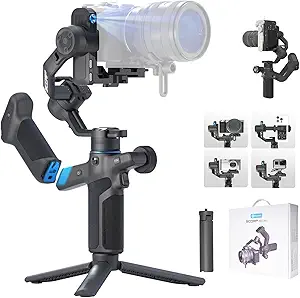 | Best Multi-Camera Gimbal | Payload capacity: 4.4 lbs (2 kg) | Tracking distance: 18 meters | Response time: 0.003 seconds | VIEW ON AMAZON | See Our Full Breakdown |
| DJI RS 4 Gimbal Stabilizer for Camera |  | Best for Professional Mirrorless Rigs | Payload capacity: 3 kg (6.6 lbs) | Extended tilt axis: Extended by 8.5 mm | Battery runtime: Up to 29.5 hours with optional BG70 grip | VIEW ON AMAZON | See Our Full Breakdown |
| gimbal stabilizers for videography | Stabilization |
|---|---|
| AOCHUAN Smart XE 3-Axis Foldab | 3-axis |
| DJI Osmo Mobile 7P + Mic Mini | 3-axis |
| hohem iSteady V3 Ultra 3-Axis | 3-axis, iSteady 9.0 |
| COMITOK L7C Pro 3-Axis Smartph | 3-axis |
| DJI RS 4 Mini Gimbal Stabilize | — |
| Hohem iSteady Pro 4 3-Axis Spl | 3-axis; iSteady 5.0 anti-shake technology |
| DJI Osmo Mobile 8 Standard Com | 3-axis |
| Hohem iSteady X3 SE 3-Axis Gim | 3-axis, iSteady 8.0 |
| DJI RS 3 Mini Camera Gimbal St | 3rd-generation RS stabilization algorithm |
| DJI Osmo Mobile 7P 3-Axis Smar | 3-axis |
| DJI Osmo Mobile 8 3-Axis Phone | 3-axis |
| DJI Osmo Mobile 7 3-Axis Gimba | 3-axis |
| FeiyuTech SCORP Mini-3-Pro Gim | — |
| DJI RS 4 Gimbal Stabilizer for | — |
More Details on Our Top Picks
AOCHUAN Smart XE 3-Axis Foldable Gimbal Stabilizer for Smartphones
The AOCHUAN Smart XE is a practical pick for phone videographers who want three-axis stabilization and tracking controls in a foldable setup. At 0.78 lb, it is easy to carry between locations, while face tracking and gesture control can help solo creators frame and start shots without reaching for the phone. Its focus wheel and zoom slider also give more hands-on control than the COMITOK L7C Pro, which emphasizes app-based tracking and creative modes. The Smart XE supports both horizontal and vertical shooting, so it can serve mixed social and landscape workflows.
The tradeoff is that Android compatibility can vary, and tracking and camera modes rely on the companion app. Its 280 g phone limit rules out heavier phone-and-accessory setups. The 10-hour rated battery is useful for longer outings, but this is still a smartphone tool, not a camera gimbal like the DJI RS 4 Mini.
Pros:- Foldable 0.78 lb design is convenient for mobile shooting
- Face tracking and gesture control support solo operation
- Focus wheel and zoom slider add direct shooting controls
- Supports horizontal and vertical shooting with up to 10 hours of rated battery life
Cons:- Android compatibility may vary by phone
- Maximum recommended phone weight is 280 g
- Phone is not included
Best for: Solo smartphone creators who want a foldable gimbal with tracking, gesture control, and both vertical and horizontal framing.
Not ideal for: Videographers using heavier phone rigs, uncertain Android models, or interchangeable-lens cameras; its phone compatibility and 280 g load limit narrow the fit.
- Brand and model:AOCHUAN Smart XE
- Stabilization:3-axis
- Compatibility:iPhone and most Android smartphones
- Maximum recommended phone weight:280 g
- Weight:0.78 lb
- Battery:2600 mAh; rated up to 10 hours
- Controls and modes:Face tracking, gesture control, focus wheel, zoom slider, horizontal and vertical shooting
- Included items:Gimbal, tripod, USB-C charging cable, user manual
Our verdict“Choose the AOCHUAN Smart XE for portable, feature-rich phone videography if your phone fits its load and app compatibility limits.”
DJI Osmo Mobile 7P + Mic Mini TX (Infinity Black), Gimbal Stabilizer
The DJI Osmo Mobile 7P kit suits smartphone videographers who want more than stabilization in one setup. Its three-axis system is paired with intelligent tracking, built-in lighting, and audio reception, while the included Mic Mini transmitter addresses a common weakness of phone footage: usable sound. An extension rod, tripod, and magnetic phone clamp give creators more framing options than the simpler AOCHUAN Smart XE package, which includes a tripod but not a microphone or lighting module.
This broader toolkit also brings more setup and compatibility friction. DJI Mimo must be downloaded from DJI’s official website due to platform restrictions, and some Android devices may not work with the app. The included accessories make the 7P a stronger choice for someone building a mobile content kit, but a creator who only needs stabilization may find the AOCHUAN’s simpler feature set easier to live with. Battery life is rated at up to 10 hours.
Pros:- Three-axis stabilization with intelligent tracking
- Included Mic Mini transmitter and audio-reception functionality support spoken video
- Built-in lighting, extension rod, tripod, and magnetic phone clamp expand shooting options
- Battery life rated up to 10 hours
Cons:- DJI Mimo must be downloaded from DJI’s official website
- Some Android devices have limited compatibility due to app restrictions
- Multifunctional accessories can make setup more involved than simpler phone gimbals
Best for: Mobile creators who film spoken content and want stabilization, a microphone transmitter, lighting, and an extension rod in one kit.
Not ideal for: Android users whose phones have limited app compatibility, or videographers who want a straightforward gimbal without extra modules and setup steps.
- Brand and model:DJI Osmo Mobile 7P
- Stabilization:3-axis
- Compatibility:iPhone and Android; compatibility can vary by device
- Tracking and lighting:Intelligent tracking and built-in lighting
- Battery life:Up to 10 hours
- Included audio equipment:DJI Mic Mini transmitter and multifunctional module
- Included accessories:Magnetic phone clamp, extension rod, tripod, charging cables, storage pouch
- App requirement:DJI Mimo download from DJI’s official website
Our verdict“Pick the DJI Osmo Mobile 7P kit if audio, lighting, and flexible framing matter as much as stabilized smartphone footage.”
hohem iSteady V3 Ultra 3-Axis Smartphone Gimbal Stabilizer
The hohem iSteady V3 Ultra is the standout here for creators who need to frame themselves or follow moving subjects from a distance. Its detachable touchscreen remote works up to 33 ft away, giving it a practical advantage over the AOCHUAN Smart XE’s gesture controls when the operator needs to step away from the gimbal. AI tracking covers faces, pets, and objects, and the built-in tripod, fill light, and 8-inch extension rod add useful options for solo filming.
That versatility comes with a firm load ceiling: the phone must weigh no more than 14.11 oz, so a large phone with accessories may be a poor match. Its battery is rated for up to nine hours, an hour less than the AOCHUAN and DJI Osmo Mobile 7P. At 15.1 oz and a folded length of 6.3 inches, it remains portable, but buyers should prioritize the remote and tracking features over maximum runtime or payload.
Pros:- Detachable 1.22-inch touchscreen remote works up to 33 ft away
- AI tracking supports faces, pets, and objects
- Built-in tripod, fill light, and 8-inch extension rod add shooting flexibility
- Folded length of 6.3 inches and weight of 15.1 oz suit mobile use
Cons:- Maximum phone load is limited to 14.11 oz
- Rated battery life is up to nine hours, below the AOCHUAN Smart XE and DJI Osmo Mobile 7P
- Remote and tracking features may be unnecessary for simple handheld phone shots
Best for: Solo creators filming themselves, pets, or moving subjects who want remote framing and tracking from up to 33 ft away.
Not ideal for: Videographers using heavy phone cases or add-ons, or those who need longer rated runtime than nine hours.
- Brand and model:Hohem iSteady V3 Ultra
- Stabilization:3-axis, iSteady 9.0
- Tracking:AI tracking for faces, pets, and objects
- Remote:Detachable 1.22-inch touchscreen; range up to 33 ft
- Maximum phone load:14.11 oz
- Weight and folded length:15.1 oz; 6.3 inches
- Battery life:Up to 9 hours
- Included features and accessories:8-inch extension rod, magnetic AI tracker with fill light, USB-C cable, hex key, storage pouch
Our verdict“Choose the iSteady V3 Ultra if remote control and broad subject tracking make solo shooting easier than a basic phone gimbal can.”
COMITOK L7C Pro 3-Axis Smartphone Gimbal Stabilizer with AI Tracking
The COMITOK L7C Pro makes sense for smartphone videographers who want a foldable three-axis stabilizer without a leveling routine. Its no-leveling setup is the clearest distinction from feature-heavy options such as the DJI Osmo Mobile 7P, while face and object tracking and gesture controls cover common solo-filming tasks. The included grip tripod and wrist strap support quick placement and handling, and its folded dimensions of 6 × 4.3 × 1.8 inches make it easy to pack.
The limits are mostly about fit and app dependence. Phones must be under seven inches and weigh no more than 0.62 lb; tracking and creative modes also require the companion app. Unlike the AOCHUAN Smart XE, the provided data does not specify battery runtime, so I would not choose the COMITOK for a shoot where long operating time is a deciding factor. Its 80-minute charging time is useful, but the listed capacity alone does not establish how long it will run.
Pros:- No leveling required for setup
- Folded dimensions of 6 × 4.3 × 1.8 inches make it compact to pack
- Face and object tracking plus gesture controls support solo filming
- Includes a grip tripod and wrist strap
Cons:- Phone must be under 7 inches and weigh no more than 0.62 lb
- Tracking and creative modes require the companion app
- Product data does not specify battery runtime
Best for: Phone videographers who value quick setup, a compact folded form, and basic tracking for short shoots.
Not ideal for: Creators with larger or heavier phones, or anyone who needs a documented long battery runtime and prefers not to rely on a companion app.
- Brand and model:COMITOK L7C Pro
- Stabilization:3-axis
- Phone compatibility:Smartphones under 7 inches and up to 0.62 lb
- Tracking and controls:Face and object tracking, gesture controls, app-based creative modes
- Weight:0.8 lb
- Folded dimensions:6 × 4.3 × 1.8 inches
- Battery and charging:2600 mAh; charging time about 80 minutes
- Included accessories:Grip tripod, Type-C USB power cable, user manual, wrist strap
Our verdict“Choose the COMITOK L7C Pro for compact, quick-start phone videography if your device fits and app-based features suit your workflow.”
DJI RS 4 Mini Gimbal Stabilizer for Camera, Compatible with Canon, Sony, Nikon, Fujifilm
The DJI RS 4 Mini is the camera-focused choice in this group, built for videographers who have outgrown smartphone-only stabilization. Its 2 kg payload supports compatible cameras and smartphones, while auto axis locks help speed setup and storage. The ability to switch from horizontal to vertical shooting in about 10 seconds is useful for creators who publish both widescreen video and vertical clips. Compared with the AOCHUAN Smart XE or hohem iSteady V3 Ultra, this is the route to take when an interchangeable-lens camera matters more than phone-first portability.
Its capacity still sets a boundary: heavier professional camera builds exceed the stated 2 kg limit, and the feature set may feel like unnecessary complexity for casual phone filming. App compatibility issues may also require updates from DJI’s website. The included tracking module, tripod, and briefcase handle make it more adaptable for controlled shoots, but the product data does not specify battery life, so I would not rank it for runtime-sensitive work.
Pros:- Supports cameras and smartphones up to 2 kg
- Auto axis locks can speed setup and storage
- Switches between horizontal and vertical shooting in about 10 seconds
- Includes a tracking module, tripod, and briefcase handle
Cons:- 2 kg payload excludes heavier professional camera builds
- App compatibility issues may require updates from DJI’s website
- Feature set can be more involved than needed for casual phone videography
Best for: Videographers using a compatible lightweight mirrorless camera who need quick vertical switching and a compact camera-gimbal setup.
Not ideal for: Operators with heavier camera-and-lens rigs or casual smartphone creators who do not need camera-gimbal controls and setup.
- Brand and model:DJI RS 4 Mini
- Payload capacity:2 kg / 4.4 lb
- Supported devices:Cameras and smartphones
- Vertical shooting:Supported
- Auto axis locks:Yes
- Horizontal-to-vertical switch time:About 10 seconds
- Included accessories:Tripod, tracking module, briefcase handle
- App note:Compatibility issues may require updates from DJI’s website
Our verdict“Pick the DJI RS 4 Mini if your videography calls for a camera-capable gimbal and your full rig stays within its 2 kg payload.”
Hohem iSteady Pro 4 3-Axis Splashproof Action Camera Gimbal
The iSteady Pro 4 is the action-camera specialist in this group: its three-axis stabilization and iSteady 5.0 technology are built for compatible compact cameras, not phones or mirrorless rigs. Its IPX4 splash protection and ability to charge a camera while filming suit outdoor shoots where light rain or extended recording is a concern. The listed battery life reaches 14 hours, longer than the DJI Osmo Mobile 8’s stated 10 hours, though those models serve different camera types. Compatibility needs a close check: supported GoPros can use Bluetooth shutter control, but some compatible cameras—including the DJI Osmo Action and Insta360 ONE R—cannot be controlled from the gimbal. It also excludes GoPro HERO7 White and Silver models, and its 160 g weight recommendation limits camera choices.
Pros:- Three-axis stabilization with iSteady 5.0 anti-shake technology
- Up to 14 hours of battery life
- Can charge a compatible action camera while recording
- IPX4 protection against water splashes
Cons:- Bluetooth shutter control is limited to supported GoPro models
- Not compatible with GoPro HERO7 White and Silver
- 160 g maximum weight recommendation restricts camera and accessory combinations
Best for: Action-camera owners using a supported GoPro or similarly sized camera who want splash protection and long shooting sessions.
Not ideal for: Creators who need integrated start/stop control for a DJI Osmo Action or Insta360 ONE R, or who use a GoPro HERO7 White or Silver.
- Stabilization:3-axis; iSteady 5.0 anti-shake technology
- Water resistance:IPX4 splashproof
- Battery life:Up to 14 hours
- Maximum weight recommendation:160 g
- Compatible cameras:GoPro HERO 3–13, DJI Osmo Action, Insta360 ONE R, and other similarly sized action cameras
- Camera control:Bluetooth shutter control for supported GoPro models
- Camera charging:Can charge a camera while recording
- Warranty:1 year
Our verdict“Choose the iSteady Pro 4 for a supported lightweight action camera and splash-prone shoots, but check control compatibility before buying.”
DJI Osmo Mobile 8 Standard Combo Phone Gimbal Stabilizer
The DJI Osmo Mobile 8 Standard Combo suits smartphone videographers who want smooth three-axis footage plus more framing options than a basic handheld gimbal. Its built-in extension rod and tripod make solo pieces to camera, group shots, and stable stationary filming easier without adding those supports separately. The 360° horizontal rotation also gives it a different framing advantage over the Hohem iSteady X3 SE, whose listed features focus on foldability and a detachable remote. The tradeoff is that the Osmo Mobile 8 arrives without its Multifunctional Module, so tracking, audio, and fill-light features tied to that module require a separate purchase. Android users should also account for the listing’s note that DJI Mimo is unavailable on Google Play.
Pros:- Three-axis stabilization for smartphone footage
- 360° horizontal rotation supports flexible framing
- Built-in extension rod and tripod
- Can charge a connected phone while filming
Cons:- Multifunctional Module is not included in the Standard Combo
- DJI Mimo is unavailable on Google Play according to the listing
- Up to 10 hours of battery life is shorter than the iSteady X3 SE’s stated 11 hours
Best for: Phone videographers who want a built-in extension rod and tripod for solo recording, group shots, and varied horizontal framing.
Not ideal for: Buyers who expect tracking, audio, or fill-light functions from the Multifunctional Module in the box, or Android users who prefer installing apps only through Google Play.
- Stabilization:3-axis
- Pan rotation:360° horizontal
- Battery life:Up to 10 hours
- Built-in features:Extension rod and tripod
- Phone charging:Can charge a connected phone while filming
- Included accessories:Magnetic Phone Clamp, USB-C to USB-C phone charging/audio cable (15 cm), USB-C to USB-C power cable (50 cm), storage pouch
- Multifunctional Module:Sold separately; not included
Our verdict“Pick the Osmo Mobile 8 Standard Combo if its built-in rod, tripod, and rotating phone platform matter more than having the tracking module included.”
Hohem iSteady X3 SE 3-Axis Gimbal Stabilizer for iPhone and Android, Black
For smartphone creators who often film themselves or need to start a shot from a distance, the iSteady X3 SE has a particularly useful feature: its detachable remote works from up to 32.81 feet away. That makes it more suited to unattended framing than the DJI Osmo Mobile 8 Standard Combo, whose listed package emphasizes its built-in extension rod and tripod instead. The foldable body, portrait and landscape support, and Hohem Joy app features—including AI tracking, gesture control, and templates—round out a flexible phone-focused setup. Its limits are practical: the payload tops out at 0.66 lb, so heavier phone and accessory combinations may not fit. The app is part of the creative feature set, which may not suit buyers who want to avoid companion-app workflows.
Pros:- Detachable remote operates up to 32.81 feet away
- Foldable design supports portrait and landscape shooting
- Hohem Joy app includes AI tracking, gesture control, and creative templates
- Up to 11 hours of operation after a 2-hour charge
Cons:- 0.66 lb payload capacity limits heavier phones and accessory setups
- Creative tracking and gesture features depend on the Hohem Joy app
Best for: Solo smartphone videographers who want to frame shots remotely, switch between portrait and landscape, and use app-based tracking.
Not ideal for: People using phones heavier than 0.66 lb with accessories, or creators who want a gimbal for action cameras or mirrorless cameras.
- Stabilization:3-axis, iSteady 8.0
- Weight:0.79 lb
- Payload capacity:0.66 lb
- Battery life:Up to 11 hours
- Charging time:2 hours
- Remote range:Up to 32.81 ft
- App:Hohem Joy
- Compatible devices:iPhone and Android smartphones
- Included accessories:Remote controller, tripod, storage pouch, Type-C charging cable, quick start guide, warranty card
Our verdict“Choose the iSteady X3 SE for remote-controlled smartphone framing and app-based shooting features, provided your phone stays within its payload limit.”
DJI RS 3 Mini Camera Gimbal Stabilizer
Unlike the phone and action-camera options here, the DJI RS 3 Mini is made for mirrorless cameras, with a stated payload range of 0.4–2 kg. That gives videographers room to use compatible camera-and-lens combinations while keeping the gimbal lighter than a full-size camera rig. Its native vertical shooting is a clear advantage for creators who regularly deliver portrait video; the smartphone gimbals, such as the Hohem iSteady X3 SE, are simpler choices if a phone is the camera. The touchscreen and Bluetooth shutter control also keep key adjustments and capture functions close at hand. The compromises are compatibility and setup: support depends on DJI’s camera list, and the Ronin app must be downloaded from DJI’s website for activation and full functionality.
Pros:- Supports camera payloads up to 2 kg
- Native vertical shooting avoids relying on a phone-style gimbal
- 1.4-inch full-color touchscreen
- Bluetooth shutter control for photo capture and video recording
Cons:- Camera compatibility depends on DJI’s supported camera list
- Ronin app must be downloaded from DJI’s website for activation and full functionality
- Heavier and more involved than the smartphone gimbals in this roundup
Best for: Mirrorless-camera videographers seeking a compact stabilizer for supported camera-and-lens combinations, including portrait-oriented shoots.
Not ideal for: Smartphone or action-camera users, and mirrorless owners whose specific camera setup is absent from DJI’s supported compatibility list.
- Weight:795 g (1.75 lbs) in portrait mode; 850 g (1.8 lbs) with horizontal arm
- Payload capacity:0.4–2 kg (0.8–4.4 lbs)
- Stabilization:3rd-generation RS stabilization algorithm
- Display:1.4-inch full-color touchscreen
- Connectivity:Bluetooth shutter control
- Supported shooting orientation:Native vertical shooting
- Included accessories:Quick-release plate, tripod, USB-C charging cable, multi-camera control cable, mounting screws
Our verdict“Choose the RS 3 Mini if you need camera-grade stabilization for a supported mirrorless setup and value compactness and native vertical shooting.”
DJI Osmo Mobile 7P 3-Axis Smartphone Gimbal Stabilizer
The Osmo Mobile 7P is the more feature-packed phone pick for creators who want tracking, lighting, and compatible DJI microphone reception in one included Multifunctional Module. That makes it a more complete out-of-box creator setup than the Osmo Mobile 8 Standard Combo, which does not include its Multifunctional Module. Its built-in extension rod and tripod also help with solo filming, while quick launch supports faster starts when a shot comes together unexpectedly. The tradeoff is the DJI Mimo app: the listing says it is not available on Google Play, so Android users must download it from DJI’s website. Unlike the camera-focused RS 3 Mini, this is strictly a smartphone stabilizer, and its stated operating time reaches up to 10 hours.
Pros:- Three-axis stabilization for smartphone video
- Included Multifunctional Module supports subject tracking, lighting, and compatible DJI microphone reception
- Built-in extension rod and tripod
- Quick launch and up to 10 hours of operating time
Cons:- DJI Mimo is not available on Google Play according to the listing
- Android users must download the app from DJI’s website
- Designed for smartphones rather than interchangeable-lens cameras
Best for: iPhone and Android creators who want smartphone stabilization with included subject tracking, fill lighting, compatible microphone reception, and a built-in tripod.
Not ideal for: Mirrorless-camera or action-camera videographers, and Android users who do not want to install DJI Mimo from DJI’s website.
- Stabilization:3-axis
- Compatibility:iPhone and Android smartphones
- Maximum operating time:Up to 10 hours
- Built-in features:Extension rod, tripod, quick launch
- Multifunctional Module:Included; supports subject tracking, lighting, and compatible DJI microphone reception
- Included components:Gimbal, Multifunctional Module, magnetic phone clamp, USB-C cables, storage pouch
- App availability:DJI Mimo is not available on Google Play; Android users must download it from DJI’s website
Our verdict“Choose the Osmo Mobile 7P if you want an all-in-one smartphone creator kit with its tracking and lighting module included.”
DJI Osmo Mobile 8 3-Axis Phone Gimbal Stabilizer
I’d choose the Osmo Mobile 8 when a phone-based videographer wants more framing options without carrying separate support gear. Its built-in extension rod and tripod make it easier to capture wider group shots, higher angles, or a stationary take, while 360° horizontal pan rotation supports continuous movement. The multifunctional module adds subject tracking, audio, and lighting capabilities, giving it a broader shooting toolkit than the more basic Osmo Mobile 7. Battery life reaches up to 10 hours, and the gimbal can charge a connected phone, useful on longer shoots. The tradeoff is that it remains a phone-only stabilizer, unlike the FeiyuTech SCORP Mini-3-Pro, which can support multiple camera types. Android users should also account for downloading DJI Mimo outside Google Play.
Pros:- Three-axis stabilization helps steady moving phone footage.
- Built-in extension rod and tripod support more framing and stationary shooting options.
- Multifunctional module adds tracking, audio, and lighting capabilities.
- Up to 10-hour battery life with the ability to charge a connected phone.
Cons:- Designed for phone shooting rather than interchangeable-lens or compact cameras.
- DJI Mimo must be downloaded from DJI’s website because it is unavailable on Google Play.
Best for: Phone videographers who shoot solo and want tracking, adjustable reach, and a built-in tripod for varied angles.
Not ideal for: Creators who need to stabilize a mirrorless or compact camera, or Android users who only want apps installed through Google Play.
- Brand:DJI
- Model:Osmo Mobile 8
- Stabilization:3-axis
- Pan rotation:360° horizontal
- Battery life:Up to 10 hours
- Built-in features:Extension rod and tripod
- Included module:Multifunctional module for audio and lighting
Our verdict“Choose the Osmo Mobile 8 if you want a feature-rich phone gimbal with built-in reach and support; choose a camera-compatible model if your kit goes beyond a smartphone.”
DJI Osmo Mobile 7 3-Axis Gimbal Stabilizer for iPhone and Android
The Osmo Mobile 7 suits phone creators who want dependable stabilization and tracking in a foldable, relatively light package. At 300 g, it is easier to carry between locations than the 4.4 lb FeiyuTech SCORP Mini-3-Pro, though that heavier gimbal supports cameras beyond smartphones. ActiveTrack 7.0 helps keep a moving subject framed, while the built-in tripod is useful for a solo creator recording a fixed shot. Its 10-hour operating time and USB-C phone charging add practical flexibility for a full day of filming. Compared with the Osmo Mobile 8, this model has fewer listed shooting extras: it lacks the 8’s built-in extension rod and multifunctional audio-and-lighting module. DJI Mimo’s website download requirement is another friction point for Android users.
Pros:- 300 g weight and foldable design make it convenient to carry.
- ActiveTrack 7.0 supports tracking moving subjects.
- Built-in tripod helps with stationary solo filming.
- Up to 10 hours of operation and USB-C phone charging.
Cons:- Limited to smartphone use, unlike the camera-compatible FeiyuTech SCORP Mini-3-Pro.
- DJI Mimo is unavailable on Google Play and must be downloaded from DJI’s website.
Best for: Mobile filmmakers who prioritize a light, foldable stabilizer for walking shots, subject tracking, and occasional tripod setups.
Not ideal for: Videographers who need a gimbal for mirrorless, compact, or action cameras, or who want an integrated extension rod and audio-and-lighting module.
- Brand:DJI
- Model:Osmo Mobile 7 (DS307)
- Stabilization:3-axis
- Tracking:ActiveTrack 7.0
- Weight:300 g
- Maximum operating time:10 hours
- Features:Foldable design, built-in tripod, USB-C phone charging
Our verdict“Pick the Osmo Mobile 7 for a lightweight, tracking-capable phone gimbal, but choose the Osmo Mobile 8 if its added extension and multifunctional module matter to your shoots.”
FeiyuTech SCORP Mini-3-Pro Gimbal Stabilizer for Camera, Smartphone, and Action Cameras
The SCORP Mini-3-Pro is the flexible choice for videographers who move between a mirrorless camera, smartphone, compact camera, and action camera. Its 4.4 lb (2 kg) payload opens up shooting setups that the phone-only Osmo Mobile 7 cannot handle, while AI tracking and an 18-meter tracking distance support solo filming from farther away. A detachable remote handle gives the operator another way to control shots, particularly when a standard handheld position is awkward. That range comes with a real carrying and setup cost: the gimbal itself weighs 4.4 lb, and its controls and compatibility options may take more learning than a phone-first stabilizer. Compared with the DJI RS 4, it covers more device categories, but its stated payload is lower than the RS 4’s 3 kg.
Pros:- Supports mirrorless, compact, smartphone, and action cameras.
- 4.4 lb (2 kg) payload accommodates more than a phone-only stabilizer.
- AI tracking is specified for distances up to 18 meters.
- Detachable remote handle adds control and shooting flexibility.
Cons:- At 4.4 lb, it can be tiring to hold for extended handheld filming.
- Multi-camera setup and controls may require more learning than the DJI Osmo Mobile 7.
- Its 2 kg payload is below the DJI RS 4’s 3 kg capacity.
Best for: Videographers who alternate among mirrorless, compact, smartphone, and action cameras and want one stabilizer for mixed-camera shoots.
Not ideal for: Casual phone shooters or operators planning long handheld sessions who would rather carry a lighter, simpler phone gimbal.
- Payload capacity:4.4 lbs (2 kg)
- Tracking distance:18 meters
- Response time:0.003 seconds
- Compatibility:Mirrorless cameras, compact cameras, smartphones, and action cameras
- Weight:4.4 lbs
- Charging:USB-C
- Warranty:1 year
Our verdict“Choose the SCORP Mini-3-Pro if you need one gimbal across several camera types and can accept extra weight and setup complexity.”
DJI RS 4 Gimbal Stabilizer for Camera
For a videographer building around a mirrorless camera and lens, the DJI RS 4 offers the most substantial camera-focused capacity in this group: its 3 kg payload exceeds the FeiyuTech SCORP Mini-3-Pro’s 2 kg limit. Native vertical shooting mode makes portrait-oriented work more direct, and an 8.5 mm extended tilt axis gives more room for balancing compatible camera setups. Teflon-coated axes are intended to support smoother balancing, while the RSA communication port expands control options. This is a different class of tool from the phone-first Osmo Mobile 8, but it also demands more commitment: changing between horizontal and vertical shooting requires rebalancing. The advertised runtime of up to 29.5 hours depends on the optional BG70 grip, and the DJI Ronin app must be downloaded from DJI’s website.
Pros:- 3 kg payload supports heavier mirrorless camera-and-lens setups than the SCORP Mini-3-Pro.
- Native vertical shooting mode supports portrait-oriented video.
- Extended tilt axis adds balancing room for camera setups.
- Teflon-coated axes support smoother balancing.
Cons:- Switching between horizontal and vertical modes requires rebalancing.
- The up-to-29.5-hour runtime requires the separately sold BG70 grip.
- DJI Ronin app must be downloaded from DJI’s website because it is unavailable on Google Play.
Best for: Professional and advanced mirrorless-camera creators who need a 3 kg payload, portrait shooting, and control options for extended production work.
Not ideal for: Phone-only creators, lightweight travel videographers, or anyone who needs frequent orientation changes without time to rebalance.
- Payload capacity:3 kg (6.6 lbs)
- Extended tilt axis:Extended by 8.5 mm
- Battery runtime:Up to 29.5 hours with optional BG70 grip
- Control port:RSA communication port
- Compatibility:Canon, Sony, Nikon, and Fujifilm mirrorless cameras
- App:DJI Ronin app; download from DJI’s website
Our verdict“Choose the RS 4 for a higher-payload mirrorless rig and frequent portrait-format work, provided you can accommodate rebalancing and the optional grip for its longest runtime.”

How We Picked
I ranked these gimbals around the work a videographer needs them to do: stabilize the intended device, suit its weight and balance requirements, and remain practical to set up and carry. I separated smartphone, action-camera, and interchangeable-lens camera models rather than comparing them as if they had the same job. I also considered handling, portability, tracking and control features, build and weather suitability where specified, and the usefulness of included accessories.
The ranking favors products with a clear fit and a useful balance of capability and day-to-day convenience. That puts the DJI RS 4 Mini ahead for many camera users, while the Osmo Mobile 7P leads among phone-focused options; neither can replace the other. More specialized picks rank for their particular strengths, not for universal appeal. Before buying, I’d confirm compatibility with the exact phone, camera, lens, and accessories in the planned rig, since payload and balance can change what a gimbal can support.
Factors to Consider When Choosing Gimbal Stabilizers For Videography
Choosing a gimbal is less about collecting the most features and more about matching the stabilizer to the footage you actually make. I’d start with the device and rig, then weigh setup time, movement style, and how much supporting gear you want to carry.
Match the gimbal to the complete camera rig
Check compatibility against the full shooting setup, not just the camera body. A lens, microphone, cage, filter, cable, or monitor can add weight and shift the center of gravity, making a setup harder to balance or unsuitable for the gimbal. Payload capacity is only part of the question: the camera also needs to sit within the gimbal’s adjustment range. A common mistake is choosing a camera stabilizer based on a bare-body weight and adding accessories later. For a phone model, check phone dimensions and case fit as well as whether the features you want work with your device. If your rig changes between shoots, leave headroom rather than buying to the tightest possible fit.
Choose for shooting pace, not just stabilization
Fast setup and repeatable balance matter when you film short takes, move between locations, or work without an assistant. A more capable camera gimbal may offer more flexibility, but that advantage is less useful if balancing it slows down a run-and-gun shoot. Phone stabilizers typically make sense for quick clips and lightweight movement, while camera models suit rigs that justify more preparation. Check how easily the arms lock, whether the controls are accessible while filming, and how the device handles changes in orientation. If you mostly record planned scenes, setup time may matter less than rig support. Avoid paying for complexity you will rarely use.
Treat tracking as a convenience, not a replacement for framing
AI or subject tracking can keep a moving person in frame while you present, demonstrate, or film alone. It does not make every shot better: a tracking system can follow the wrong subject, react awkwardly to movement, or limit the camera motion you intended. Think through whether you need the gimbal to follow a person automatically or whether you prefer to control framing yourself. Also check how tracking is activated and whether it depends on an app, a particular phone, or an accessory. For interviews and repeatable compositions, manual framing may be more predictable. Pay extra for tracking when it solves a recurring solo-shoot problem, not simply because it appears on a feature list.
Account for microphones and other accessories
Audio gear changes the value of a bundle when spoken content is central to your videos. A package that includes a transmitter may save setup steps, but it still needs to suit your recording workflow, phone or camera connections, and desired audio placement. Accessories also add bulk and may affect how a rig balances, so check whether they mount cleanly without blocking controls or movement. Do not assume that every included item works with every device in the same way. If you already own a microphone system, a simpler gimbal may be a better match than a bundle with overlapping equipment. If you are building a kit from scratch, compare the convenience of a matched package with the flexibility of choosing separate components.
Let shooting conditions set your durability needs
Weather and environment should shape the shortlist before portability or extra modes do. A splashproof action-camera gimbal addresses a different risk from a phone stabilizer intended for everyday indoor or outdoor clips. Splash resistance should not be read as permission to submerge gear or expose it to conditions outside the maker’s stated limits. Dust, sand, salt spray, and sudden temperature changes can also affect moving parts and require more care after a shoot. If you film around water or in rough locations, check protection claims and cleaning guidance carefully. For controlled studio work, specialized environmental protection may add less value than easier balancing or broader camera compatibility.
Think about transport and maintenance over the whole shoot
A compact folded form helps only if the gimbal is convenient in use. Consider the stabilizer, tripod, cables, phone mount, batteries, and carrying case as one package, especially when you walk between locations. Frequent camera changes can mean rebalancing, so look at how your workflow handles switching lenses or devices rather than focusing only on storage size. Moving arms and clamps benefit from careful handling; forceful packing or leaving a gimbal powered on in a bag can cause problems. Check how the model is charged and whether its controls and app setup fit your routine. A slightly larger option can be the better buy if it reduces setup friction or better supports the gear you already carry.
Frequently Asked Questions
Can I use a smartphone gimbal with a mirrorless camera?
No—the phone-focused models in this roundup are built around smartphones, while camera gimbals such as the DJI RS 4 Mini and RS 4 are designed for interchangeable-lens camera rigs. A phone gimbal’s clamp and motors are not a safe substitute for the correct camera support. Even among camera gimbals, compatibility depends on camera, lens, and accessory weight and balance, not just the brand. Check the maker’s compatibility information for your complete rig before buying. If you switch between a phone and a camera often, a multi-device model may be appealing, but confirm that it supports each device in a practical way.
Is a larger camera gimbal worth carrying if I mostly shoot travel videos?
It is worth carrying when your camera rig needs the extra support or you rely on controlled camera movement that a phone stabilizer cannot provide. For lightweight travel clips made on a smartphone, a compact phone gimbal is usually easier to pack and set up. If you bring a mirrorless camera, lens, and microphone, a camera gimbal may be the more suitable tool even though it adds bulk. Think about how often you will actually take it out during a trip, not just whether it fits in your bag. A stabilizer that stays packed because it is cumbersome offers little practical benefit.
Do I need AI tracking if I film myself?
Tracking can help when you move around while filming alone, such as during a demonstration or a walking presentation. It is less necessary for a fixed talking-head setup, where a tripod and careful framing may be simpler. Tracking performance and control methods can vary, so confirm whether the feature works with your phone and whether it needs an app or an additional component. It may also follow the wrong person in a busy setting or reframe when you want a locked shot. Choose it for a specific solo-filming task rather than treating it as a general upgrade.
Should I buy a gimbal bundle that includes a microphone?
A microphone bundle makes sense when it fits your recording setup and saves you from sourcing separate audio gear. Before choosing one, check the connection method, compatibility with your phone or camera, and whether the transmitter can be used comfortably during the kinds of shots you make. If you already own a reliable microphone, a bundle may duplicate equipment and add items to carry. Audio needs can also vary by setting: a nearby presenter, a moving subject, and outdoor ambience call for different approaches. Compare the included setup with the gear you own rather than choosing by bundle size alone.
What should I check before buying a gimbal for a camera with accessories?
Weigh and balance the full rig, including the lens, cage, microphone, filter, cables, and any monitor you plan to attach. Then verify the exact combination against the gimbal maker’s compatibility guidance; payload figures by themselves do not confirm that a rig will balance correctly. Check that the camera can move through the intended range without hitting an arm or accessory. Leave room for future additions if your setup often changes. When compatibility remains unclear, confirm it with the manufacturer before ordering rather than assuming a similar camera model will fit.
Conclusion
For the best overall camera-focused balance, I’d choose the DJI RS 4 Mini; for a larger rig with greater demands, the DJI RS 4 is the premium pick. Among phone gimbals, the DJI Osmo Mobile 7P is my leading all-around choice, particularly for creators who value its bundled Mic Mini TX, while the Osmo Mobile 7 is a sensible simpler alternative. Beginners who want a phone-first setup can start with the Hohem iSteady X3 SE or a DJI Osmo Mobile model suited to their phone and accessory needs. For tracking-focused phone videos, consider the hohem iSteady V3 Ultra; for action-camera work around splashes, look at the Hohem iSteady Pro 4; and for a stabilizer spanning several device types, examine the FeiyuTech SCORP Mini-3-Pro. My final recommendation is to match the gimbal to your complete rig and shooting conditions before choosing extras.